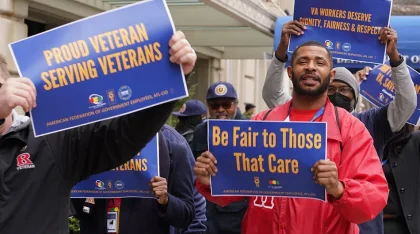
Members of the American Federation of Government Employees protest the VA’s termination of most of its agreements with employee unions. Photo from AFGE website
WASHINGTON, DC — VA has announced that it would be terminating most of its agreements with employee unions, effective immediately.
The announcement last month made VA the first federal agency to carry through with a March executive order designating many federal agencies exempt from collective-bargaining rights due to national security issues.
Unions challenged the order in court, arguing it was a retaliatory action against unions who had filed lawsuits against the administration.
In June, a federal judge placed a temporary injunction on the order. On Aug. 1, the U.S. Court of Appeals lifted that injunction. Five days later, VA informed the American Federation of Government Employees (AFGE), National Association of Government Employees, National Federation of Federal Employees, National Nurses United and the Service Employees International Union that it had canceled their collective-bargaining agreements.
The move strips union protections from approximately three-quarters of the department’s 480,000-person workforce. While federal employee unions cannot bargain for pay and benefits and do not have the right to strike, they have bargained for conditions of employment, such as staffing levels, pay and employment protections, in addition to providing legal support to employees. Contracts covering approximately 4,000 VA police, security guards and firefighters will remain in place.
In his executive order last March, President Donald Trump cited a provision in the 1978 Civil Service Reform Act that allows him to declare the work done by certain federal agencies to be a matter of national security and thus ineligible for collective bargaining by unions. In addition to VA, the order also listed the State Department, DOD and many offices within HHS among others.
While the reasoning around the executive order was national security, VA’s statement announcing the contract cancellation focused on efficiency and cost savings, framing union activities as a distraction from taking care of veterans. According to the department, 1,900 bargaining-unit employees spent 750,000 of work time on union activities, and 187,000 square feet of facility space is being used for union activities free of charge. Those hours cannot be used to “serve veterans instead of union bosses,” VA’s announcement stated.
The department also says that removing union protections will make it easier to fire employees it deems unfit.
“Too often, unions that represent VA employees fight against the best interests of veterans while protecting and rewarding bad workers,” VA Secretary Doug Collins said.
Union leaders view this last statement as confirmation that the contract cancellations are at least in part retaliatory.
“The real reason Collins wants AFGE out of the VA is because we have successfully fought against disastrous, anti-veteran recommendations from the Asset Infrastructure Review (AIR) Commission which would have shut down several rural VA hospitals and clinics, opposed the Trump administration’s plan dismantle veteran health care through the cutting of 83,000 jobs and consistently educated the American people about how private, for-profit veteran healthcare is more expensive and results in worse outcomes for veterans,” declared AFGE President Everett Kelley. “We don’t apologize for protecting veteran healthcare and will continue to fight for our members and the veterans they care for.”
Other evidence backs up Kelley’s claim of retaliation. A White House fact sheet detailing the reasoning behind the executive order noted that “certain federal unions have declared war on President Trump’s agenda” and the largest federal union, the American Federation of Government Employees (AFGE) is “widely filing grievances to block Trump policies.”
In April, VA announced the exemption of eight smaller unions that had not been involved in litigation from the executive order.
Union protections and patient care are not at odds, with studies showing that patient care improves in hospitals where nurses are unionized, National Nurses United pointed out in a statement following VA’s announcement. “We will continue to fight for and assert our constitutionally guaranteed collective-bargaining rights and to speak freely against policies that hurt veterans and the public,” the statement declared. “That is our duty as nurses, and we will continue to be fierce advocates for our patients.”