
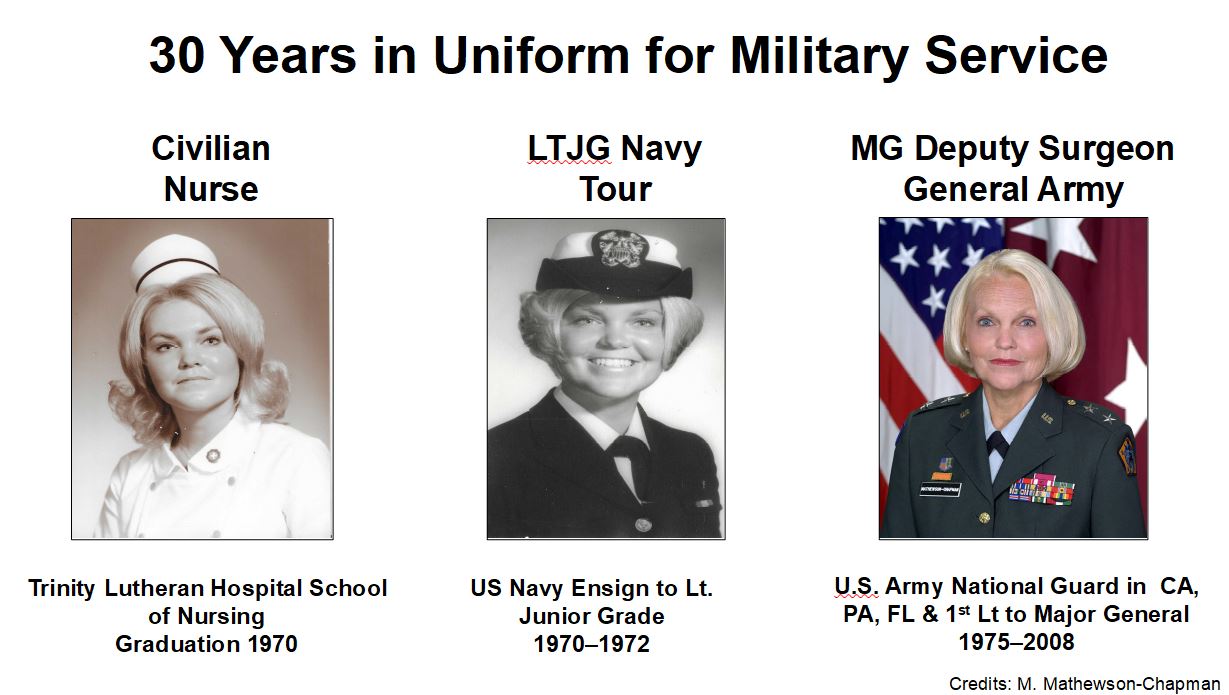
 PHOENIX — A powerful health care advocate specializing in oncology, retired Maj. Gen. Marianne Mathewson-Chapman, PhD., brought both her military leadership and her personal experience as a breast cancer patient to the forefront when she addressed the Association of VA Hematology/Oncology (AVAHO) annual meeting last month in Phoenix.
In her remarks, she shared how nurse navigators shaped her cancer journey at two different VAMCs, underscoring the essential role they play in supporting veterans through treatment.
Mathewson-Chapman was the first woman in the Army National Guard to be promoted to the rank of major general. Her active military service began in 1970 when she was commissioned in the Navy Nurse Corps. Over the course of her distinguished career, she served as deputy surgeon general and special assistant to the surgeon general of the U.S. Army, as well as director of the Army National Guard.
Her military career made her no stranger to hostile environments and difficult assignments, experiences she needed to draw on as she faced a far more personal battle against breast cancer, an enemy that proved unexpectedly persistent.
As in military conflict, Mathewson-Chapman realized she needed to lead with integrity, adapt under fire to triumph and never, ever give up. The battlefield was different, but she faced the same fight for survival.
First Diagnosis
First diagnosed with ductal carcinoma in situ (DCIS) in late 2012, Mathewson-Chapman underwent surgery followed by radiation therapy in early 2013 while working full-time for the VA in Washington, DC. The absence of patient support services and distance from family left her feeling very isolated, with little control over her treatment or schedule.
“I was in a new place, in D.C. I didn’t know anybody, especially at the hospital, as the start of treatment was the first time I’d ever been there. It took me a while—Metro plus the bus—to get there, and I was still working, so I had to try to get radiation late in the afternoon so I could leave work early,” she recalled.
The clinical team provided competent treatment, but there was no one to guide her through what to expect or connect her to supportive services. A revolving parade of medical staff scheduled appointments and recommended treatment steps without communicating any overall plan or discussing goals.
“People I didn’t know would come and talk to me. They just said, ‘Come here, come there,’ and then scheduled a biopsy. That was kind of the D.C. VA approach. I was alone the whole time,” Mathewson-Chapman said.
Recurrence and New Experience
After completing 5 years of hormone therapy following that initial diagnosis, Mathewson-Chapman thought her cancer journey was behind her. She retired and moved back to Florida, where 5 years later new findings indicated the cancer had returned, this time invasive.
Now receiving care at the Bay Pines VAMC, Mathewson-Chapman quickly found herself on an accelerated treatment schedule.
“I thought I could wait, not rush into anything. But the surgeon said, ‘No, the best thing is a mastectomy.’ That threw me for a loop. This was a Thursday. He said, ‘I can put you on the schedule for Monday, because I’m going on vacation Tuesday, so make up your mind.’ I didn’t really have a choice. I had to get it done.”
This time, however, she was introduced to a cancer nurse navigator, Cindy Bowman, MSN, RN, OCN, who transformed her care experience.
‘Angels Without Wings’
“I had no idea who this was, but she seemed to have everything under control and knew what I needed to do and who I needed to see. I called her my angel without wings, because she took me step by step. She was able to get into my records and tell me what the plans were when I was just too emotionally involved to even try to find out.”
The navigator arranged appointments with mental health services, dietitians and lymphedema specialists—services that Mathewson-Chapman had not even realized were available. “I had no idea who was here, who I should see. Cindy made sure of it. She became my guardian.”
The contrast between her two experiences illustrates why nurse navigation is particularly valuable for women veterans. At her first facility, she was one of very few female patients, received little guidance and felt distanced from her care. At the second VAMC, her nurse navigator offered continuity and advocacy.
“I just hope that all women have that, and all the VAs have that now,” she said. The issue extends beyond her own case: Her younger sister, also a veteran, was diagnosed with DCIS two years ago but was referred to a civilian doctor in Arkansas because her VA facility lacked oncology services, Mathewson-Chapman told U.S. Medicine. “They didn’t have nurse navigators, because the facility really didn’t have the capability to coordinate anything.”
Mathewson-Chapman continues treatment for her breast cancer today.
Five years of anti-estrogen therapy present daily challenges, but multidisciplinary care continues to help her navigate the side effects of treatment.
“Not having estrogen makes a big difference in your body and how you look. The dietitian told me to eat certain foods and avoid others. That helped. But the biggest problem has been sleeping. That’s been tough. I’m on several websites where they list all the possible side effects. I’ve had them all.”
She also benefited from proactive lymphedema prevention. “I had seen military friends with swollen arms and hands after breast cancer, and I didn’t want that. The lymphedema specialist instructed me, gave me an arm sleeve and hand support, taught me how to massage the lymph system so it could drain. I see her every six months. It’s been wonderful.”
Warrior Spirit
Like many veterans, Mathewson-Chapman drew on her military training to frame the cancer fight. “That’s why in my speech I called it ‘warrior strength’ or ‘warrior spirit.’ We’re trained to prepare for battle. Whether healthy or not, you need the mindset to be prepared for what may come.”
“Cindy became part of my battle plan—guiding me through everything, checking in frequently,” Mathewson-Chapman added. “The warrior spirit is critical, especially for military people: You’re going to be prepared, you’re going to survive, you’re going to do well. You can’t do it by yourself. It helps to have your angel guiding you.”
Beyond Clinical Care
Mathewson-Chapman’s story highlights how cancer affects work and identity. While in treatment the first time, her supervisors saw only productivity without awareness or consideration of the personal cost.
After weeks of coming in early and leaving early for radiation, Mathewson-Chapman was drained but determined to maintain her productivity. The response from supervisors took her by surprise.
“They said, ‘You’re doing so well. We’ve got two more projects we want you to head up.’ That was the moment I knew it was time to retire. People don’t understand what you’re going through unless they’ve been through it,” she said.
She also found value in humor and community resources. She described receiving a “knitted knocker,” a soft, adjustable prosthesis handmade by volunteers. “How did they know that’s the one thing women hate—being lopsided? They send them out free to women [who have had mastectomies]. It really helps you feel like a woman again.”
A Call for Broader Access
Her journey underscores why nurse navigators are indispensable in cancer care, especially for women veterans, who are often treated in facilities designed around the needs of men. “I wish every woman at every VA had that,” she emphasized.
Nurse navigators don’t just explain treatment; they stand with patients in moments of shock, ensure follow-through on care plans and connect veterans to services that protect their physical and emotional well-being.
As Mathewson-Chapman’s experience shows, these essential healthcare advocates and coordinators embody the “warrior spirit” alongside their patients, making sure no one fights breast cancer alone.