Unsecured Firearms in Storage Also an Issue
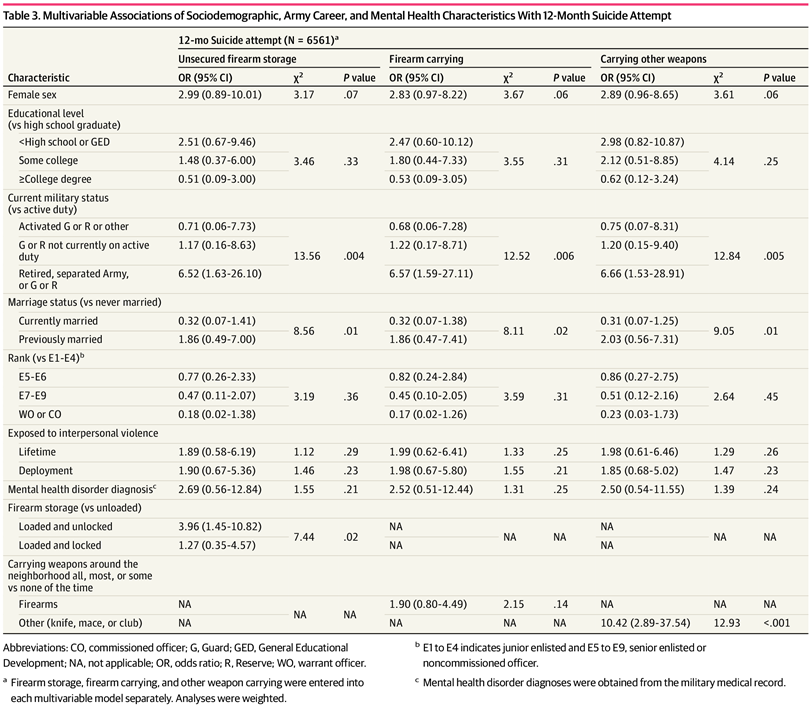
Click to Enlarge: Multivariable Associations of Sociodemographic, Army Career, and Mental Health Characteristics With 12-Month Suicide Attempt Source: JAMA Network Open
BETHESDA, MD — Among U.S. Army servicemembers who own firearms, carrying them, as well as other weapons, and storing them unsecured are associated with greater risk of suicide, according to a recent study.
The cross-sectional study published in JAMA Network Open examined whether firearm storage and carrying practices and carrying of other weapons is associated with suicidal behaviors in military servicemembers who own personal firearms.1
Suicide is a critical public health issue for military servicemembers. In 2023, the suicide rates among U.S. Army active-duty soldiers grew to 34.8 per 100,000 and remained high compared with age- and sex-adjusted rates in civilians. Firearms are the most common suicide method among military servicemembers, used in more than 65% of suicide deaths of U.S. Army active-duty servicemembers, compared with 50% in the general population.
The study authors are affiliated with the Uniformed Services University of the Health Sciences and Henry M. Jackson Foundation for the Advancement of Military Medicine Inc. in Bethesda, MD; Southeast Louisiana Veterans Health Care System in New Orleans, LA; University of Southern Florida in Tampa, FL; and Harvard University in Cambridge, MA.
Studies have found the presence of a firearm in the home is associated with considerably increased risk of death by suicide. Around 50% of military servicemembers and veterans own firearms compared to about 38% of adults in the general population. Ready access to a firearm may increase risk of suicide-related outcomes when suicidal ideation develops. Despite the known risk factors, the relationship of improper firearm storage—loaded and unlocked—and carrying practices, as well as carrying behaviors for other weapons (e.g., a knife, mace or a club), with suicide risk remains understudied, the researchers explained.
This study used data from participants in the Army Study to Assess Risk and Resilience in Servicemembers-Longitudinal Study Wave 2 (STARRS-LSWS) survey, which was collected April 2018 to July 2019. The survey assessed a wide range of risk and protective factors for suicide. Servicemembers and veterans completed interviews and consented to administrative linkage to U.S. Army-DoD administrative records. The study included 12,022 total U.S. Army servicemembers, with 6,561 firearm owners (54.5%) and 5,461 servicemembers who didn’t own firearms (45.4%).
Participants were mostly male (10,096 or 83.6%), with a mean age of 32 years old. Of the participants, 785 (6.8%) were Asian or other race and ethnicity; 1,516 (16.1%) were Black; 1,405 (11.9%) were Hispanic; and 8,316 (65.2%) were White. A total of 4,621 participants (42.7%) had a rank of E1 to E4 (junior enlisted). Age of entry in the Army was between 17 and 20 years old for 6,444 participants (55.6%). Among the participants, 4,459 (37.4%) had 1 to 4 years of active service and 9,424 (77.1%) had a history of prior deployment. Regarding mental health disorders, most gun owners (3,793 or 58.1%) and participants who didn’t own guns (2,932 or 53.0%) didn’t have a history of mental health disorders from the military medical record. Statistical analyses were conducted from June 2022 to January 2025.
The study found that firearm storage behavior and carrying behavior of weapons, not just firearms, may serve as indicators of increased suicide risk among military servicemembers. The results suggest that suicide risk interventions should target all weapons. The findings also strengthen understanding of the risks associated with certain firearm practices and may help identify individuals for targeted suicide prevention interventions, the investigators pointed out.
After controlling for lifetime mental health disorders and history of stressful life events, the researchers determined that unsecured firearm storage practices (loaded and unlocked) were significantly associated with increased suicide risk across all time frames compared to secure storage (unloaded). Also, carrying a weapon other than a firearm was associated with heightened suicide risk.
The researchers discovered that firearm owners with unsecured storage were more likely to report a suicide attempt in the past 12 months. In addition, carrying a weapon other than a firearm (e.g., a knife, mace or a club) was associated with increased suicide attempt risk in the past 12 months.
The authors recommended that secure storage interventions such as lethal means counseling may be useful tools to decrease risk of suicide death among firearm-owning U.S. Army servicemembers.
Further research on this topic is needed. In the future, study authors suggested using STARRS-LSW2 data to study potential associations between suicidal ideation and attempt and firearm behaviors. They also recommended further examination of the relationship between threat perception and anxiety and fear instability and how those features relate to suicidal ideation and attempt. Investigators also suggested future studies on other potential environmental systems that link geographic location, firearm laws, firearm behaviors and suicidal behaviors.
Limitations of the study include that researchers were unable to determine causality between firearm storage and carrying behaviors and suicide ideation and attempt because the data were cross-sectional. Findings were also based on surveys of living participants, with few suicide deaths in the sample. Data also lacked information on suicide attempt methods. The authors noted that since firearm attempts are highly lethal, as high as 90%, few living respondents of firearm suicide attempts would likely be included among survey respondents.
The study also didn’t evaluate threat perception, but it did control for history of mental health disorders from the military medical record, including post-traumatic stress disorder (PTSD) diagnosis, which involves hypervigilance for threat. Lastly, the data, which reflect active-duty servicemembers and recently discharged veterans, may not be generalizable to civilians, the researchers explained.
- Dempsey CL, West JC, Houtsma C, Ao J, Bossarte R, et. Al. Firearm Storage and Carrying Practices and Suicidal Behaviors in US Army Service Members. JAMA Netw Open. 2026 Apr 1;9(4):e268268. doi: 10.1001/jamanetworkopen.2026.8268. PMID: 42012829; PMCID: PMC13100839.