

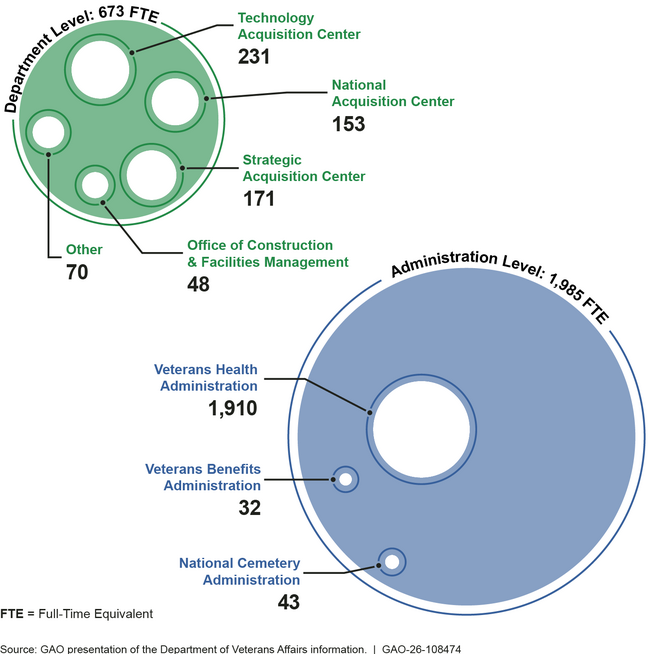
Click to Enlarge: Number of Full-Time Equivalent (FTE) Veterans Affairs Contracting Officials (as of November 2025)
WASHINGTON, DC — VA has historically had long-standing challenges in executing and managing its healthcare related acquisitions, and recent staffing cuts will only exacerbate those problems, according to a recent report from the Government Accountability Office (GAO).
Staff reductions in 2025 left acquisition centers across the department down an average of 15% of their full-time-equivalent (FTE) contracting officials as compared to last year. This includes VHA, as well as facilities management, technology acquisition and VBA, which is down a total of 20% of its contracting staff. This reduction comes after previous GAO warnings that VA needed to ensure it has the staff to not only keep up with acquisitions but strengthen an already deficient system.
VA contract obligations totaled more than $78 billion in fiscal year 2025—the second highest among federal agencies. This represents a 166% increase since 2016, mostly due to the expansion of community care, the contracts for which totaled almost $32 billion in FY2025.
VA’s acquisition system has been on GAO’s high-risk list since 2019, but it was the pandemic that provided a stark relief to the department’s supply chain weaknesses. Multiple purchasing and tracking streams create extensive overlap between departments resulting in an enterprise-wide lack of visibility of what facilities had what supplies and where they were buying them.
While inconsistent leadership and lack of strategic planning are the primary causes identified in early GAO reports, a 2024 report also focused on the need for sufficient staff.
“In 2024, we recommended that the department ensure that its human capital plans address workforce capacity needed to oversee its service contracts,” GAO investigators wrote in the most recent report. “This step would ensure that VA’s acquisition workforce—including program managers and contracting officer’s representatives—is of sufficient size and capability needed to conduct oversight of contracts involving functions that need heightened management attention.”
VA concurred with that 2024 recommendation but have yet to implement it. Instead, VA told GAO that it has taken other steps, including reviewing its training curriculum for how to manage major acquisitions.
Still, leaders of several VA acquisition organizations informed investigators that their offices had key gaps following last year’s staff reductions, causing some of them to scale back aspects of their office’s work.
To complicate matters, VA is making plans for an agency-wide reorganization effort, which would consolidate acquisitions from VHA, VBA and National Cemeteries under the department-level Office of Acquisitions, Logistics, and Construction. In the long run, this should improve VA’s ability to track its contracting obligations; however, as of February 2026, the department had yet to develop a plan addressing all the elements of the reorganizations of its acquisition functions.
According to GAO, strategic workforce planning can be key to a major reorganization.
“Our leading practices note that successful structural changes rely on having a capable workforce to implement them,” the report states. “We previously found that strategic workforce planning should precede any staff realignments or downsizing, so that changed staff levels do not inadvertently produce skills gaps or other adverse effects that could result in increased use of overtime or contracted support.”
However, following President Donald Trump’s February 2025 executive order directing agencies to undertake sweeping layoffs of federal employees, the Office of Management and Budget instructed VA to focus on cuts first and make plans to reorganize them afterward, the investigators stated.
Despite this, the GAO report contends that VA can still make good strategic choices going forward.
“By conducting strategic workforce planning before initiating reforms, agencies can develop targeted training and recruitment activities to address any projected gaps in expertise that could result from the effort,” the report states. “Even though contracting staff reductions have already occurred, VA has an opportunity to conduct this type of planning. By reviewing workforce functions in advance of implementing reforms, VA can determine the mission critical skills it will need to meet its mission in a transformed environment. The agency could then take steps to close any mission critical skills gaps it identified.”
The original memorandum to merge the acquisition responsibilities of the three administrations within VA had a goal of completion by the end of September 2026.