
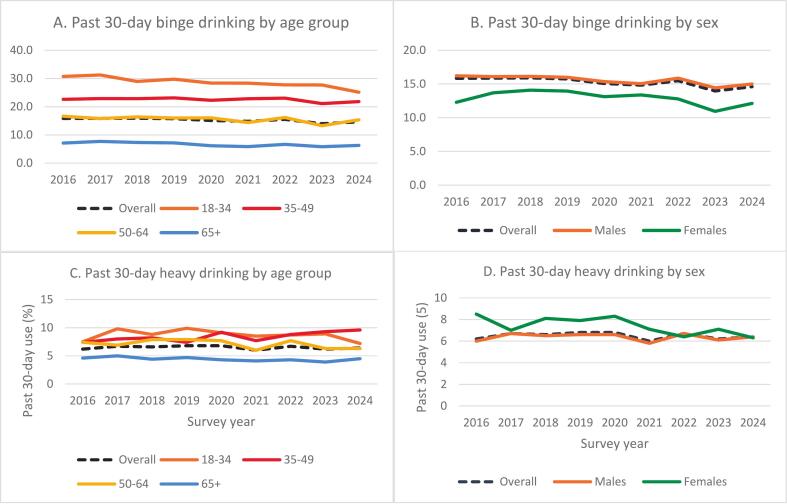
Click to Enlarge: Past 30-day binge drinking and heavy drinking prevalence among Veterans, stratified by age group and sex. Source: Addictive Behavior Reports
LOS ANGELES — Binge drinking declined from 2016 to 2024 in younger and older age groups among U.S. veterans, but, at the same time, heavy drinking increased significantly in midlife veterans, according to a recent study.
The cross-sectional study published in Addictive Behaviors Reports examined trends in and correlates of binge and heavy alcohol use among veterans across age and sex.1
Excessive alcohol consumption, which includes binge and heavy drinking, is a significant public health issue for veterans, with alcohol contributing to adverse health outcomes, such as morbidity, premature mortality and reduced quality of life. Compared to the general population, veterans consistently report higher rates of alcohol use, triggered by combat-related trauma, post-traumatic stress disorder (PTSD), transition stress and social isolation. In addition, military and veteran cultural norms might normalize and reinforce alcohol use, study authors explained.
The alcohol-use patterns differ in binge drinking and heavy drinking. Binge drinking involves four or more drinks for women or five or more drinks for men on a single occasion. Heavy drinking involves eight or more drinks for women or 15 or more drinks for men during a week, according to the national Centers for Disease Control and Prevention (CDC). The researchers said they pursued this study because examining recent trends in binge and heavy drinking patterns would offer a more thorough understanding of alcohol-related risk among veterans. Also, few studies have investigated differences by age or sex or included associations with social risk factors.
In the study, the investigators used nationally representative Behavioral Risk Factor Surveillance System (BRFSS) data from 2016 to 2024. The annual telephone survey across all 50 states and participating U.S. territories collects information on health-related behaviors. The study combined multiple survey years of repeated annual cross-sectional samples, and participants weren’t followed longitudinally. Statistical analyses were used to examine correlates of binge and heavy drinking.
The researchers found that, despite overall declines, binge and heavy drinking remained prevalent among veterans. Binge drinking declined, especially among veterans aged 18 to 34 and 65 to 80 years old. Heavy drinking remained stable overall, but it increased significantly among midlife veterans aged 35 to 49 years old. Poor mental health was associated with heavy drinking.
Having military-related insurance was linked to lower binge drinking, while tobacco use and care barriers were linked to heavy drinking. Males consistently displayed higher levels of binge drinking compared to females.
Meanwhile, women showed a notable decline in heavy drinking (8.5% to 6.3%), joining with men by 2024 and narrowing sex differences over time. The VA’s expanded focus on women veterans’ health over the past two decades, including substance use-related resources, may have improved opportunities for screening, early identification, counseling and linkage to treatment, according to study authors.
“Binge drinking declined for the youngest veterans, which is promising, as this has typically been the heaviest using group,” Eric R. Pedersen, PhD, co-author of a study on binge drinking and veterans in Psychology of Addictive Behaviors and the Della Martin Associate Professor of Psychiatry and Behavioral Sciences at Keck School of Medicine, University of Southern California, told U.S. Medicine.
“However, the good news about younger veterans shouldn’t obscure a concerning trend building right behind it: Heavy drinking rose among veterans 35-49 over the same period,” Pedersen added. “This raises a real possibility that the cohort of heavy-drinking young veterans didn’t stop drinking; they just aged into midlife and stayed there. If that’s what’s happening, screening can’t stop once a veteran leaves their 20s and 30s. Providers should treat midlife as a critical, ongoing window for alcohol screening, not a lower-risk phase.”
To reduce alcohol use in veterans, the authors recommended prevention measures specific to age and sex, integrated tobacco and alcohol treatment and continued efforts to reduce financial barriers to care.
The study reinforces that screening for binge drinking and heavy alcohol use for veterans involved in the VA and other care settings shouldn’t be one-size-fits-all. Clinicians should pay particular attention to veterans, depending on their age and sex, as well as discuss reasons why veterans might be drinking, Pedersen suggested.
He noted that differences exist for veterans who are drinking socially with peers versus those who drink alone to cope with mental health symptoms. Since tobacco use was also shown to be associated with heavy drinking, if veterans indicate tobacco/nicotine use in primary-care appointments, that could be an indicator for providers to further screen for heavy alcohol use, Pedersen pointed out.
“These findings are a strong argument for integrated care,” Pedersen suggested. “The research found a graded relationship between poor mental health and heavy drinking, meaning the worse someone’s mental health, the higher their risk of heavy drinking. That overlap is exactly why siloed care falls short: A mental health group that doesn’t screen for substance use or a substance use group that doesn’t address the underlying mental health symptoms both miss part of the full picture.”
The VA is already moving toward integrated treatment models, and these results support continuing to test and expand that approach for veterans drinking at high levels. Physicians treating veterans outside the VA or without military-related insurance might also want to screen more proactively for heavy drinking, since cost-related barriers to care were linked to heavier drinking in this study, Pedersen recommended.
Limitations of the study include that self-reported measures, nonresponse bias and unmeasured factors such as genetic predisposition or deployment history may have influenced the findings. The study also might have been affected by pandemic-related changes in alcohol use. In addition, definitions of binge and heavy drinking in the BRFSS might not fully capture all drinking behavior, the researchers explained.
Future studies should evaluate military sexual trauma and deployment history, which weren’t included in this analysis and might influence unhealthy alcohol use among veterans, the study authors said. In future research, the investigators also recommended prioritizing longitudinal designs that include veterans within and outside the VA healthcare system and linking survey and clinical data to establish temporal relationships and explore potential mechanisms underlying alcohol-use behavior.
- Do VV, Qin WA, Hawes MR, Keyhani S, Hoggatt KJ, Ling PM. Trends in and correlates of unhealthy alcohol consumption among United States Veterans, 2016-2024. Addict Behav Rep. 2026 Jun 6;24:100717. doi: 10.1016/j.abrep.2026.100717. PMID: 42325422; PMCID: PMC13276145.