


Last month, Skull Base Team surgeons U.S. Army Maj. Charles Miller and U.S. Army Maj. J. Patel removed a complex brain tumor at Walter Reed National Military Medical Center in Bethesda, MD. Staff shortages have affected the quality ratings of some more common surgeries. DoD photo by Ann Brandstadter
BETHESDA, MD — The Military Health System (MHS) is often cited as a model for reducing healthcare disparities because every beneficiary is covered by the same insurance. For example, previous studies have indicated that, within the system, there has been no significant difference in rates of 90-day hospital readmissions after surgery—a measure of the effectiveness of the care provided—based upon race.
New research suggested, however, that disparities might be starting to reappear due to the MHS’s continued struggle with staff shortages, decreased number of surgeries being performed each year and long-term effects from the COVID-19 pandemic.
The new study, published in Annals of Surgery Open, was led by investigators at the Center for Health Services Research at the Uniformed Services University of the Health Sciences in Bethesda together with researchers from the Henry M. Jackson Foundation for the Advancement of Military Medicine and Harvard Medical School.
The authors suggested their study is the first to examine racial disparities in surgical outcomes within the different environments of care of the MHS following the COVID-19 pandemic.1
The researchers analyzed healthcare claims from more than 262,000 surgical procedures performed in 244,008 adult TRICARE beneficiaries between 2020 and 2023. They examined whether patients were readmitted to a hospital within 90 days of surgery, comparing outcomes at military treatment facilities (“direct care”) with those treated in civilian hospitals through the private sector.
Overall, the findings were favorable—readmissions rates did not differ significantly between military and civilian care settings, suggesting that the MHS continues to provide comparable surgical care regardless of where procedures are performed.
Closer examination showed some concerning disparities between particular groups of patients, however, according to the results. Black patients who had no major preexisting illnesses had a greater likelihood of being readmitted to the hospital within 90 days following their surgery, regardless of whether they were cared for at a military or civilian health facility. Hispanic patients with a single chronic illness also had a greater chance of readmission following surgery conducted at a military treatment center. On the other hand, Black and Hispanic patients with multiple chronic illnesses had fewer chances of being readmitted to the hospital following surgery conducted at a civilian health facility.
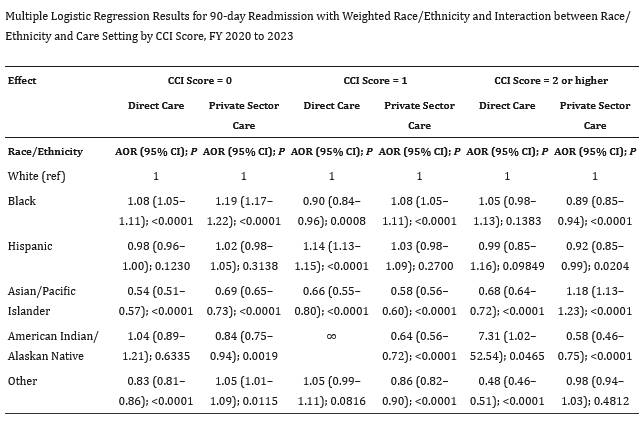
Click to Enlarge: Regression models were adjusted by categorical age, sex, marital status, rank, care setting, beneficiary category, race/ethnicity, CCI score category, and the interaction term (race/ethnicity * care setting). Source: Annals of Surgery
Although the differences were modest, the investigators said they worry that these might be warning signs. “We believe this reduction in care quality for racial and ethnic minorities is reflective of the workforce and staffing challenges, and reductions in meaningful procedural volume, that have confronted the Military Health System over the last decade and especially in the most recent three to five years that span the COVID-19 pandemic,” they wrote.
According to the authors, surgical volume within military treatment facilities has steadily declined over the past two decades, a trend that accelerated during the pandemic. Previous reports indicated that surgical experience at military hospitals fell by approximately 36% during COVID-19, potentially affecting the experience of surgical teams and the efficiency of care delivery.
The researchers say those systemwide pressures might disproportionately affect racial and ethnic minority patients. “Minority patients are likely the first to experience the effects of a struggling healthcare network due to previously recognized challenges in navigating healthcare utilization, reduced healthcare literacy, socioeconomic challenges that impact capacity to travel and greater risks of healthcare segregation,” they wrote.
The authors emphasized that the findings extend beyond military medicine. Because the MHS serves a large, geographically diverse population through a combination of military treatment facilities and civilian hospitals, they suggested that the results might provide important lessons for other large healthcare systems that rely on networks of tertiary referral centers and community hospitals.
“We believe the findings can serve as an informative model for other large healthcare networks that operate using a tiered system that combines large, tertiary referral centers with smaller community hospitals,” they wrote.
The study team said the findings carry two important messages: First, even healthcare systems with a strong history of reducing disparities can experience setbacks when staffing shortages, declining procedural volume or other operational pressures affect patient care. Second, looking only at overall quality measures might mask important differences affecting specific patient populations.
“Even if the overall performance of a system in terms of surgical care quality seems to be stable, certain segments of the population … may be experiencing healthcare disparities,” the authors wrote.
To address these concerns, the researchers recommended maintaining adequate staffing levels, increasing surgical volume within military treatment facilities when possible and routinely monitoring surgical outcomes by race, ethnicity and patient risk level.
“This message would seem to be as important for direct care facilities at this time as it is for civilian hospitals,” they concluded.
- Denteh FY, Banaag AL, Wu H, Schoenfeld AJ, Koehlmoos TP. State of Surgical Readmissions Within the Military Health System (2020-2023). Ann Surg Open. 2026 May 1;7(2):e670. doi: 10.1097/AS9.0000000000000670. PMID: 42344455; PMCID: PMC13290184.
