
GAO Report Found Weapons, Contraband Getting Into VAMCs
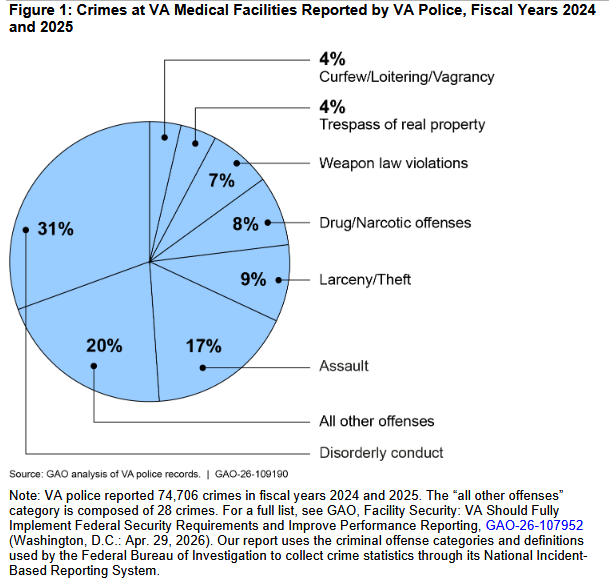
Click to Enlarge: Source: Government Accountability Office.
WASHINGTON, DC — After years of ignoring warnings that its decentralized police force resulted in inconsistent standards and lax security at hospitals, VA announced it will be overhauling the force, raising pay rates and creating a unified chain of command that it hopes will solve its long-running issues. The decision came on the heels of a Government Accountability Office (GAO) investigation during which undercover inspectors brought weapons and contraband into VA facilities with little difficulty.
For over a decade, VA policing has been the focus of GAO and VA Office of the Inspector General (OIG) reports, many of which highlighted the decentralized structure as contributing to systemic weaknesses in hospital security. In 2013, the federal government created a risk-management standard for federal buildings. That same year, GAO reported that VA’s risk-assessment methods did not align with the new standards and made recommendations to the department for how to revise them. The recommendations were never addressed.
In a 2018 OIG report on the inadequate governance of police at VA medical facilities, then-Deputy Under Secretary for Health Steve Young acknowledged that many of the problems stemmed from there being no designated staff or centralized function within VHA to manage police nationally.
“He said the decision was made years ago, and he did not have the organizational history to understand the reason,” the OIG investigators wrote.
In June, VA acknowledged that the decentralized structure was not working, calling it a “fractured police force that was plagued with problems,” and announced a six-month overhaul process to address it. The first step was placing the force under a dedicated assistant secretary within a new Office of Operations, Security, and Preparedness. The end goal is a unified chain of command that will move management of police officers away from facility leaders.
“[Prior to this], the more than 5,000 employees in VA’s police force were managed by individual VA medical facilities and reported to medical center personnel instead of law enforcement leaders,” VA said in a statement. “This led to inconsistent standards across VA facilities and a lack of discipline and accountability. VA police were being used for non-police missions, including serving as valets to park cars.”
According to VA, this new centralized structure will make it easier to hire, retain and promote officers. The department also raised the entry-level grade for police to GS-6 and created positions through the senior executive level. The low pay, lack of advancement possibilities and the requirement to answer to non-law enforcement personnel were all areas of regular complaints and poor morale among VA police officers.
“These reforms will help us accomplish [our mission] by creating a stable police force with clear lines of authority, accountability and career progression,” VA Secretary Doug Collins said.
A recent OIG audit found that, even with the new centralized system, however, VA still lacks a standardized staffing model that would allow it to determine appropriate police staffing levels for individual hospitals.
OIG first recommended VA develop such a model in 2018. Over the next several years, VA worked to create one, requiring that it be used department-wide by May 2023. According to the new audit, the project fizzled due to a lack of oversight.
“Although key VA offices agreed to work together on a police staffing model, responsible VA officials did not effectively implement internal controls over the project,” OIG reported. “VA did not clearly designate roles and responsibilities for all relevant stakeholders or monitor whether key tasks were completed. Additionally, VA did not ensure manpower management staff addressed vulnerabilities with the tool or followed their own procedures to finalize it.”
While this initial effort did not result in a final product, the work to develop it did indicate that VA’s police force was deeply understaffed. A 2020 manpower management staff summary showed VA needed 1,984 additional officers—a 45% increase over the levels at the time.
According to OIG, VA has picked up work on the tool again, with VA officials acknowledging that a validated staffing model will be needed to support its larger realignment efforts.