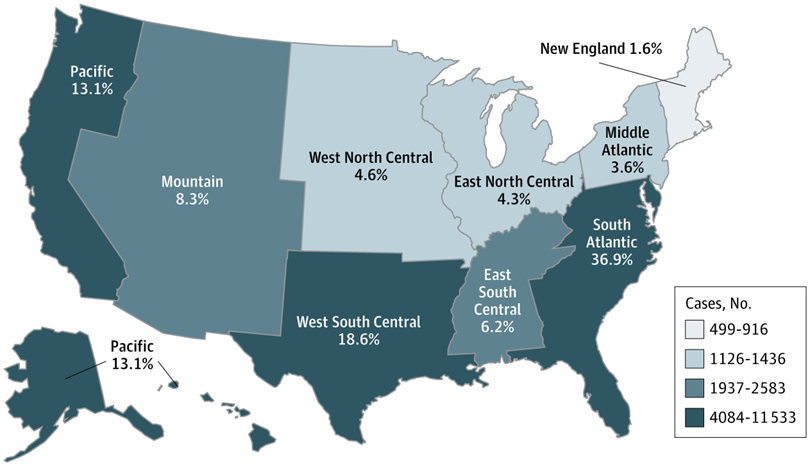
Click to Enlarge: For the purposes of this study, an asthma diagnosis is defined as having at least 1 inpatient or 2 outpatient claims with asthma in the primary or secondary diagnosis field during fiscal year 2023. Census division is determined by state of residence during the study period. Source: JAMA Network Open
BETHESDA, MD — Asthma is a common and potentially life-threatening illness that can affect children from all races and ethnicities, but the burden of asthma is not shared equally. Previous studies have shown there are racial/ethnic variations in the prevalence, treatment and outcomes of asthma; these variations can be attributed to barriers to accessing healthcare, costs associated with healthcare and the larger social determinants of health.
A recent study from the Uniformed Services University of the Health Sciences found that having health insurance does not necessarily eliminate those disparities.1
Building on research by Stewart and colleagues, who examined pediatric asthma among Military Health System (MHS) beneficiaries in 2007, researchers investigated racial and ethnic differences in asthma diagnoses, potentially avoidable hospitalizations (PAHs), emergency department (ED) visits, specialist visits and asthma-related prescription use among children enrolled in TRICARE Prime, the MHS managed care program. The MHS serves beneficiaries from diverse racial and ethnic backgrounds and covers nearly 2 million children.2
The earlier study reported an asthma prevalence of 7.2% and found higher rates of asthma-related ED visits and potentially avoidable hospitalizations among Black and Hispanic children than among white children.1
The new cross-sectional study examined fiscal year 2023 healthcare and pharmacy claims for 950,896 children age 2-17 with at least one inpatient/outpatient encounter. Of those children, 31,288, or 3.3%, met the study’s definition of asthma.2
The findings of the current study, published in JAMA Network Open, showed that the prevalence of asthma and the number of asthma-related emergency department visits and potentially preventable hospitalizations were all significantly less than those found in the previous study. However, the authors cautioned that the decline in prevalence may partly reflect changes in surveillance methods. “These national trends suggest that the decrease in our asthma cohort may be a byproduct of modified survey methods and implementation before and after the COVID-19 pandemic,” they explained.
Children who were identified as Asian, Black, Hispanic or Native Hawaiian/Pacific Islander, as well as those in the “other-race” category of the study population, experienced significantly greater odds of being diagnosed with asthma than did white children. Black children had the highest odds across all age groups, with an odds ratio of 1.85. These findings were consistent with patterns reported in earlier research.
Black, Hispanic and Native Hawaiian or Pacific Islander children were more likely to have asthma related ED visits as compared to white children. The study recorded 587 potentially avoidable hospitalizations, too few for statistically significant results.
Although Black children in the current cohort had lower odds of asthma-related ED visits than Black children in the Stewart study, disparities persisted in the MHS. “Our data indicate that even though Black children have benefited from the national trend of decreased asthma-related ED visits across all races, disparities persist among minoritized racial groups in the MHS,” the authors wrote. They suggested that access to urgent and emergency care without out-of-pocket costs may have contributed to the change in ED use, but the observational study could not establish its underlying causes.
Among children in the asthma cohort, 88.3% had a prescription for an asthma treatment, and 63.8% had an ICS prescription. Those figures were higher than in the Stewart study, in which 70.9% to 76.0% of children had an active asthma prescription and 31.1% to 34.7% had an ICS prescription.
The authors found that, as of 2019, there was an increase in ICS prescriptions following the Global Initiative for Asthma’s update to their recommendations to include either daily low-dose or symptom-driven ICS use for intermittent and mild asthma, which represented a shift away from recommending only short-acting bronchodilators. They cited barriers (e.g., cost, insurance coverage) to implementing their recommendations. “Without the barriers of cost and insurance coverage, our data may reflect better adherence to the updated Global Initiative for Asthma guidelines,” they wrote.
They also questioned if more medications usage might have led to less acute-care visits. “A potential factor associated with the decrease in hospitalizations and ED visits seen among our population could be an increase in asthma prescriptions, including ICS,” they wrote. However, they cautioned that this was a potential explanation, not a demonstrated cause.
The authors stated that their findings provide additional evidence to support the idea that having complete health insurance and access to treatments might improve asthma management. In the paper’s Discussion section, they wrote, “The current findings strengthen the evidence of how universal health coverage with low and no copayment in the MHS and effective asthma prescription and treatment regimens mitigate asthma control leading to reduced urgent care visits and overall health service utilization.”
They also noted that “decent health insurance coverage and easy access to health care is deemed beneficial in the control of asthma in the general population.”
The authors acknowledged several study limitations. Race and ethnicity were derived from military sponsors’ demographic information, which may not accurately represent dependents, particularly multiracial children, adopted children and wards. The analysis was based upon claims coding, sponsor rank was used to approximate socioeconomic status, and did not include other variables, such as BMI or pollution exposure or family history.
Despite these limitations, the authors said the findings suggested that “access to low-cost or no-cost care, consistent insurance coverage, and effective prescription practices within the MHS may have helped to improve asthma outcomes.” Still, they noted, “the persistence of racial and ethnic disparities pointed to the need for further action,” including “expanding access to culturally responsive care, increasing availability of specialists, and continuing to assess and improve how care is delivered across the system.”
- Denteh FY, Vaughan W, Banaag A, Wu H, Joseph KA, Koehlmoos TP. Pediatric Asthma in a Universally Insured Military Population. JAMA Netw Open. 2026 Jan 2;9(1):e2556740. doi: 10.1001/jamanetworkopen.2025.56740. PMID: 41587027; PMCID: PMC12836133.
- Stewart KA, Higgins PC, McLaughlin CG, Williams TV, Granger E, Croghan TW. Differences in prevalence, treatment, and outcomes of asthma among a diverse population of children with equal access to care: findings from a study in the military health system. Arch Pediatr Adolesc Med. 2010 Aug;164(8):720-6. doi: 10.1001/archpediatrics.2010.100. Epub 2010 Jun 7. PMID: 20530290.