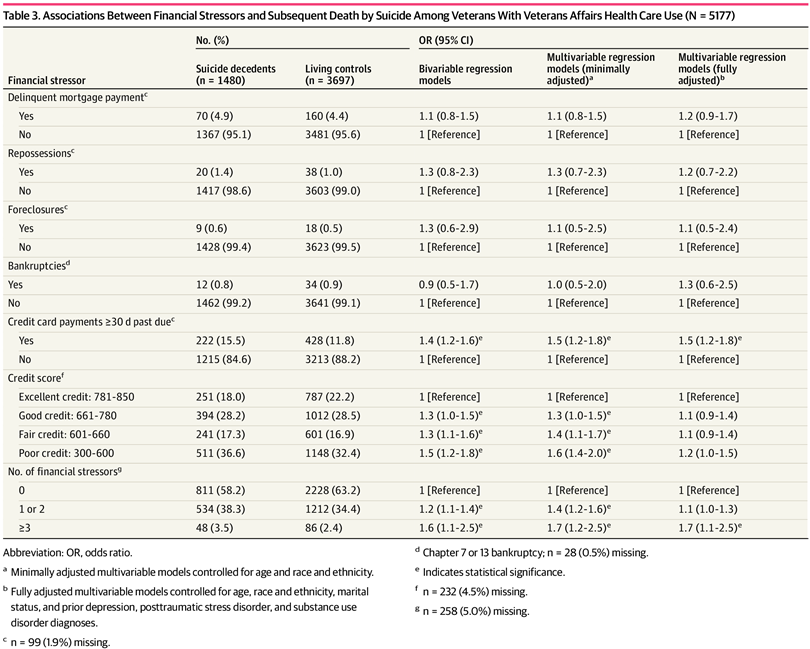
Click to Enlarge: Associations Between Financial Stressors and Subsequent Death by Suicide Among Veterans With Veterans Affairs Health Care Use (N = 5177) Source: JAMA Network Open
DURHAM, NC — Approximately 17 veterans die by suicide every day, according to the latest VA data. As such, identifying factors to assist clinicians in recognizing a veteran’s increasing suicide risk has become increasingly important. A new study pointed to one factor that might deserve more attention—financial distress.
“For years, we’ve known that suicide can be related to financial strain,” said Eric B. Elbogen, PhD, MEd, director of the VA National Veterans Financial Resource Center (FINVET) and professor of psychiatry at Duke University in Durham, NC. “There have been many studies examining this, but most have relied on surveys, employed general definitions of financial strain or measured suicidal ideation/attempts rather than actual suicide.”
The new study, published in JAMA Network Open, was conducted to address that gap through use of national credit reports and government mortality and healthcare data. Elbogen and his colleagues. analyzed financial stressors in the year prior to death for 4,993 veterans who died by suicide between January 2015 and December 2017. Financial stressors were compared to those of 12,446 living veterans, who were matched based upon age, gender, VA healthcare utilization and suicide index date.1
The researchers found that several financial problems were more common among veterans who died by suicide. These included delinquent mortgage payments, repossessions, credit card payments that were at least 30 days past due and lower credit scores. Veterans who had fallen behind on their mortgage payments had 40% higher odds of suicide than those who had not. Those who had experienced a repossession had 90% higher odds, while having a credit card payment that was at least 30 days past due was associated with 70% greater odds of suicide.
Lower credit scores were also associated with suicide, but changes in credit scores over time appeared to be particularly important. Veterans whose credit scores declined by 51 to 100 points over a year had 30% higher odds of suicide than those whose scores did not change. A decline of more than 100 points was associated with nearly three times the odds of suicide.
Elbogen said that a credit score could reflect several aspects of an individual’s financial situation and could be indicative of a pattern of declining financial health, which would not be apparent from any single occurrence.
“A credit score isn’t just a number but reflects many aspects of a person’s financial life, including missed payments, rising debt and reduced financial stability,” he said. “A declining credit score may capture the cumulative effects of mounting financial strain before that strain becomes visible in other ways.”
The association between financial stressors and suicide was strongest when veterans experienced multiple financial problems. Those with three or more financial stressors had more than twice the odds of suicide compared with those who had none.
“Our findings suggest that financial problems often accumulate rather than occur in isolation,” Elbogen said. “Veterans with three or more financial stressors … may be experiencing levels of desperation or stress that are overwhelming.”
The researchers also adjusted for demographic characteristics and, among veterans who used VA healthcare, marital status and previous diagnoses of depression, post-traumatic stress disorder and substance-use disorder.
“Because many of these financial indicators emerged during the year before death, this suggests there may be a window of opportunity to recognize worsening financial distress before a crisis develops,” Elbogen said. “A person may share these stressors with healthcare providers, but also family members, friends or financial advisers.”
“I believe financial stress deserves to become part of routine clinical conversations, because it’s both common and potentially modifiable,” he told U.S. Medicine. “Simple questions like ‘Have you been worried about paying your bills?’ or ‘Has your financial situation become significantly more stressful recently?’ can open the door to meaningful discussions.”
Because financial problems may be tied to feelings of shame or despair, creating a nonjudgmental environment is important, Elbogen said. Identifying financial distress also can allow clinicians to connect veterans with resources such as credit counselors, housing counseling agencies or other financial assistance, he said.
Among the resources available to veterans are FINVET, the National Veterans Financial Resource Center, which provides access to financial resources and education; the Veterans Benefits Banking Program, which offers free, accredited financial counseling to veterans and their families; and VSAFE, which helps veterans identify and report financial scams.
The study also pointed to questions for future research. “The next step is to move from identifying risk to reducing risk,” Elbogen said. His team wants to determine whether connecting veterans experiencing financial distress with available support services can reduce suicide risk and how healthcare systems can make those connections more effectively.
The weaker association between financial stressors and suicide among veterans who used VA healthcare suggests a question for further study: whether engagement with health care may be protective. Elbogen said that protection could come through treatment of psychiatric conditions or connections to financial, housing and employment supports.
For Elbogen, the findings pointed toward a broader approach to suicide prevention. “Taking a more holistic approach to suicide prevention—one that treats suicide not just as a mental health problem but also as a broader social problem—would be a step in that direction,” he said.
- Elbogen EB, Gilbert TA, DeBeer BB, Hooker ER, Shull S, Kimbrel NA, Pogoda TK, Chen JI, Carlson KF. Financial Stressors and Suicide. JAMA Netw Open. 2026 Jul 1;9(7):e2620981. doi: 10.1001/jamanetworkopen.2026.20981. PMID: 42507447; PMCID: PMC13409012.