
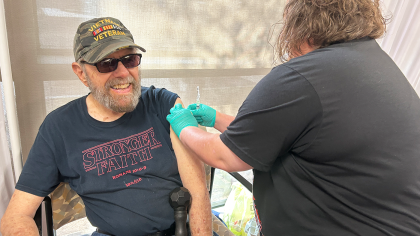
A veteran receives an influenza vaccine last year at the West Texas VA Health care System in Big Springs, TX. VA photo.
The VA offers a broad vaccine menu, reflecting a population that skews older, often has multiple comorbidities and carries exposure risks specific to military service. VA facilities generally provide COVID-19, flu, hepatitis A and B, human papilloma virus (HPV), measles/mumps/rubella (MMR), meningococcal, pneumococcal (PCV20 and PPSV23), polio, rabies, respiratory syncytial virus (RSV), shingles, tetanus/diphtheria/pertussis (Tdap) and typhoid vaccines and boosters.1
Age drives much of the list. Shingles and RSV vaccines target the herpes zoster and respiratory risks that rise with age in any population, but uptake among veterans has lagged. Among veterans on immunosuppressive medications, a group at meaningfully higher risk of shingles and its complications, only 49.8% of those 50 and older had received at least one recombinant zoster vaccine dose by mid-2023, and just 13.4% of those under 50 had, despite FDA approval extending eligibility to immunocompromised adults of any age starting in 2021. Vaccination rates varied substantially by VA facility, from 17.7% to 71.1%, suggesting the gap is about outreach as much as eligibility.2
Chronic respiratory disease adds another layer. Close to 30% of veterans reported using tobacco products as of 2018, a notably higher rate than nonveterans, and occupational exposures from burn pits, sand and dust particles and oil well fires compound the risk of chronic obstructive pulmonary disease (COPD) and other lung disease among this population.3 That combination makes pneumococcal vaccination a higher-value intervention for veterans than for age-matched civilians, as chronic lung disease sharply raises the odds of severe pneumococcal pneumonia.
Exposure history matters, too. Older veterans face much higher risks of hepatitis B and C than civilians.4,5 Hepatitis A vaccination carries its own veteran-specific rationale: ACIP recommends it for people experiencing homelessness,6 and while veteran homelessness has fallen 56% since 2010, 32,495 veterans still experienced homelessness on a single night in January 2025, a population at elevated risk during hepatitis A outbreaks tied to unstable living conditions.7
HPV vaccination, by contrast, mainly serves younger veterans and dependents, protecting against the same cervical, anal and oropharyngeal cancers it prevents in the general population, while typhoid and rabies remain travel- and occupation-specific rather than broadly recommended.
- Vaccine Preventive Care, VA Augusta health care. https://www.va.gov/augusta-health-care/programs/vaccine-preventive-care/
- Abada S, Li J, Tarasovsky G, Wilson C, Yazdany J, Whooley MA, Schmajuk G. Recombinant Zoster Vaccination Among US Veterans Receiving Immunosuppressive Medications. JAMA Netw Open. 2024 Oct 1;7(10):e2439945. doi: 10.1001/jamanetworkopen.2024.39945. PMID: 39392634; PMCID: PMC11581597.
- Robichaux C, Zanotto A, Wendt CH, Wendt CH, Michalik M, Gravely A, Baldomero AK. Rural Versus Urban Health Disparities in the COVID-19 Era Among Veterans With COPD. Chronic Obstr Pulm Dis. 2024 Sep 27;11(5):538-543. doi: 10.15326/jcopdf.2024.0521. PMID: 39213379; PMCID: PMC11548974.
- Beste LA, Ioannou GN, Chang MF, et al. Prevalence of Hepatitis B Virus Exposure in the Veterans Health Administration and Association With Military-Related Risk Factors. Clin Gastroenterol Hepatol. 2020 Apr;18(4):954-962.e6. doi: 10.1016/j.cgh.2019.07.056. Epub 2019 Aug 5. PMID: 31394284.
- Dominitz JA, Boyko EJ, Koepsell TD, et al. Elevated prevalence of hepatitis C infection in users of United States veterans medical centers. Hepatology. 2005 Jan;41(1):88-96. doi: 10.1002/hep.20502. PMID: 15619249.
- ACIP Recommendations: Hepatitis A Vaccine. CDC. July 26, 2024.
- Liu S. Taking a closer look at the 2025 Point-in Time Count Results. VA News. June 25, 2026.