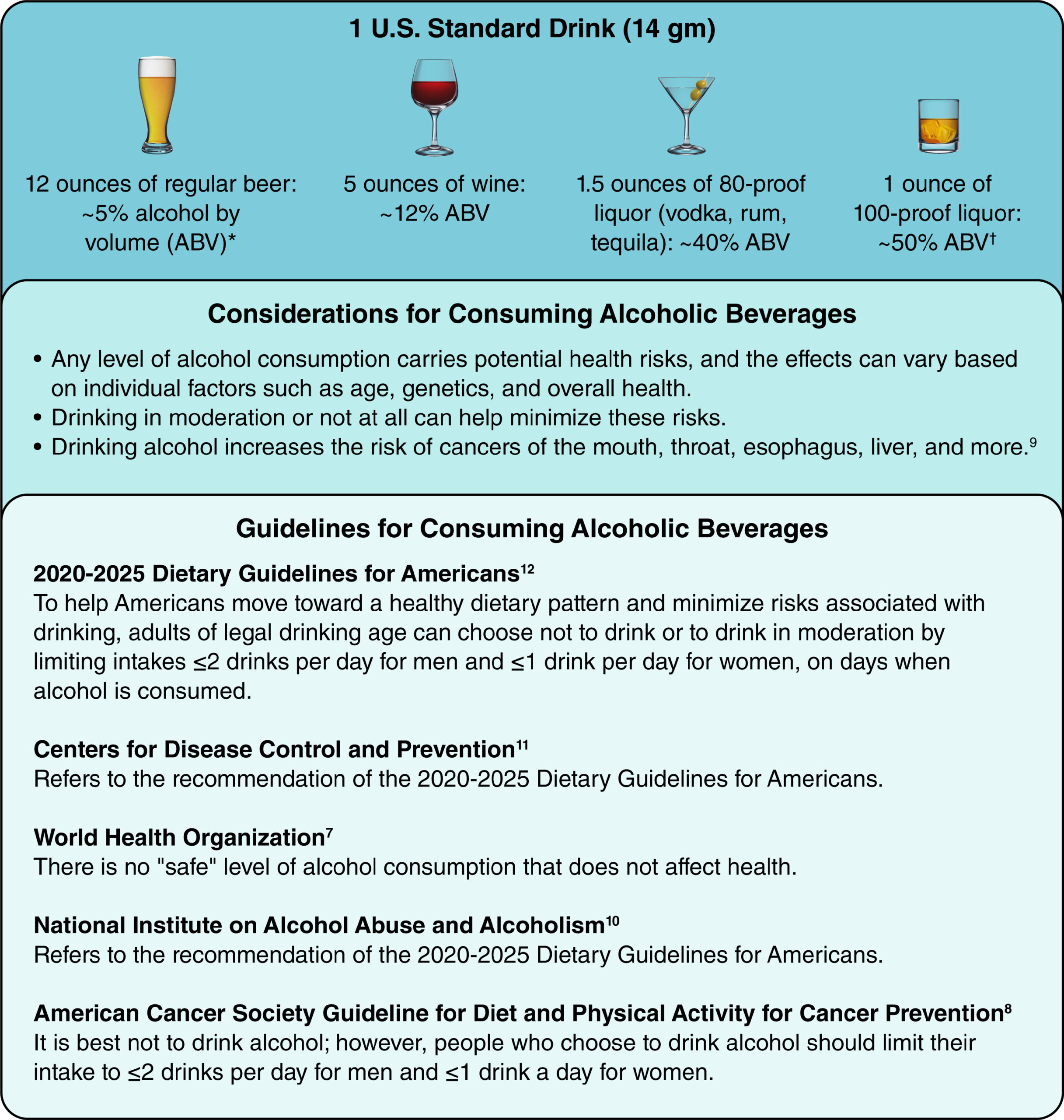
Click to Enlarge: Considerations and guidelines for consuming alcoholic beverages. *Some microbrews or India pale ales may have higher (7.5%) alcohol by volume (ABV). †Specialty crafted cocktails may also exceed 50% ABV. Source: American Heart Association
BOSTON — Alcohol’s relationship with health is complicated: The same pattern of drinking that can be associated with lower rates of cardiovascular events and death in a large study of U.S. veterans also was linked to increased cancer risk.
The study led by the VA Boston Healthcare System found that cardiovascular risk was lowest among veterans reporting moderate alcohol consumption, while cancer risk increased with higher intake. The findings illustrate how alcohol consumption can be associated with different health outcomes in different ways, the authors suggested.
In the study, published in The American Journal of Clinical Nutrition, the researchers examined self-reported alcohol consumption and its associations with major adverse cardiovascular events (MACE), cancer and all-cause mortality among 438,442 participants in the VA’s Million Veteran Program (MVP). MACE included myocardial infarction, stroke or cardiovascular death.1
At baseline, 61.2% of participants reported currently drinking alcohol, 31.7% were former drinkers, and 7.1% had never consumed alcohol. The participants had a mean age of 65.5 years; 90.9% were men, and 80.1% were non-Hispanic white.
The researchers found a J-shaped association between alcohol consumption and both mortality and MACE. Compared with never drinkers, current drinkers reporting 0.1 to 30 grams of alcohol per day had a hazard ratio of 0.86 for mortality and 0.84 for MACE—associations corresponding to 14% and 16% lower relative hazards, respectively.
The pattern was not the same for cancer. Among current drinkers, cancer risk increased with higher daily alcohol intake. Compared with the study’s reference group, the hazard ratios were 1.03 for 0.1 to 30 grams per day, 1.06 for 31 to 60 grams, 1.20 for 61 to 90 grams and 1.28 for more than 90 grams per day. The researchers reported a significant linear trend.
The findings also highlighted the relationship between smoking, alcohol and head and neck cancer. Compared with participants who reported never smoking and never drinking, the hazard ratio for head and neck cancer was 3.21 among current smokers with moderate alcohol consumption and 5.69 among current smokers who drank heavily. Moderate consumption was defined as up to 14 grams per day for women and up to 28 grams per day for men. The interaction between smoking and alcohol was statistically significant.
Study co-author Peter W.F. Wilson, MD, professor of medicine at Emory University in Atlanta, said the findings provide additional perspective on the 2025 Surgeon General’s report on alcohol intake. Wilson also is the director of Epidemiology and Genomic Medicine at the Atlanta VAMC.
“A J-shaped association was observed between the amount of self-reported alcohol intake and risk of mortality and risk of atherosclerotic heart disease in veterans,” Wilson told U.S. Medicine. “Alcohol consumption demonstrates a linear dose response relationship with cancers, with increased risks for alcohol-related cancers even at moderate consumption levels.”
The study’s results do not establish that alcohol itself caused the outcomes. “The study results are based on replies to a questionnaire administered to participants in the Million Veteran Program, a large study funded by the VA concerning health of veterans,” he explained. “The reported findings are based on statistical associations concerning self-reported smoking habit and alcohol intake.”
The cardiovascular findings were consistent with previous research reporting a J-shaped association between alcohol consumption and cardiovascular outcomes. Wilson said the MVP report “corroborated that cardiovascular disease risk was reduced in participants reporting up to 2 drinks/day in men and approximately 1 drink/day in women.”
The study’s cancer findings point to a different consideration, however. Wilson noted that self-reported alcohol was highly associated with greater risk for many cancers and that head and neck cancer risk was particularly evident among veterans who reported both smoking and drinking.
The new study’s findings add to a body of research in which alcohol has been associated with both benefits and harms, depending on the health outcome examined. The study introduction notes that several health organizations recommend moderation rather than encouraging alcohol consumption. The results neither establish that people who do not drink should begin drinking to reduce cardiovascular risk nor demonstrate that moderate drinking is risk-free.
The study relied on participants’ self-reported alcohol consumption and smoking habits, which were assessed at a single point in time. Wilson noted that this approach might not capture changes in drinking or smoking over time. In addition, the observational design means that other differences between people who drink and those who abstain could have contributed to the observed associations.
- Li Y, Nguyen XT, Houghton SC, Ho YL, Charest BR, Wang DD, Gagnon DR, Zhang Y, Gaziano JM, Willett WC, Hu FB, Cho K, Wilson PW. Association of self-reported alcohol consumption compared with abstention with major adverse cardiovascular events, cancer, and mortality among United States veterans: a cohort study from the Million Veteran Program. Am J Clin Nutr. 2026 Aug 26;124(4):101493. doi: 10.1016/j.ajcnut.2026.101493. Epub ahead of print. PMID: 42648643.
- Piano MR, et. al. on behalf the American Heart Association Council on Lifestyle and Cardiometabolic Health; Council on Cardiovascular and Stroke Nursing; Council on Clinical Cardiology; and Stroke Council. Alcohol Use and Cardiovascular Disease: A Scientific Statement From the American Heart Association. Circulation. 2025 Jul 8;152(1):e7-e21. doi: 10.1161/CIR.0000000000001341. Epub 2025 Jun 9. Erratum in: Circulation. 2026 Mar 31;153(13):e1106. doi: 10.1161/CIR.0000000000001430. PMID: 40485439.