

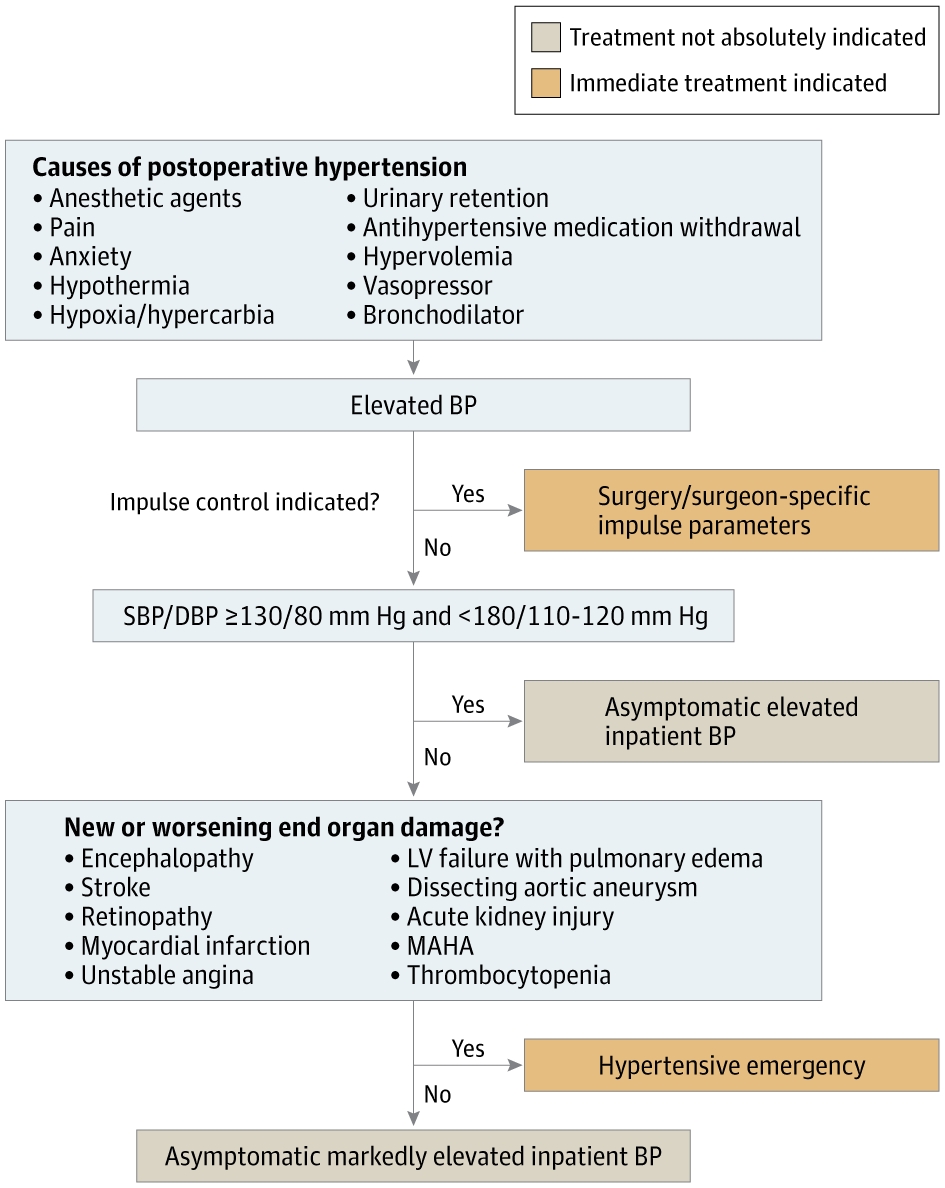
Click to Enlarge: Flowchart of Decision-Making for Elevated Blood Pressure (BP) Findings Among InpatientsDefinitions as proposed by the American Heart Association Scientific Statement in 2024.6 DBP indicates diastolic blood pressure; LV, left ventricle; MAHA, microangiopathic hemolytic anemia; SBP, systolic blood pressure. Source: JAMA Network
PALO ALTO, CA — Using medication to lower asymptomatic postoperative hypertension, a common clinical condition in admitted surgical patients, can have adverse outcomes, so postoperative hypertension should only be treated in inpatient surgical patients when it’s symptomatic, according to a recent review article.
The review published in JAMA Surgery summarized best-practice guidelines for the management of postoperative hypertension, related studies and potential consequences of overtreatment. The researchers used observational studies, meta analyses and national association guidelines.1
Hypertension, a common, long-term medical condition defined as a systolic blood pressure greater than 130 mm Hg and diastolic blood pressure greater than 80 mm Hg, affects nearly half the U.S. adult population. While hypertension management guidelines for patients in outpatient settings are well studied, treatment of high blood pressure in the inpatient setting, particularly for postoperative patients, is less understood, the researchers explained.
In postoperative patients, hypertensive blood pressure measurements, which are attributed to many factors, are common. Up to 72% of inpatients will have hypertension during acute care admissions, and 1 in 4 patients undergoing major noncardiac surgery will experience hypertension in the perioperative period. Hypertension is frequently identified and treated by inpatient surgical and nonsurgical clinicians, but the acute lowering of asymptomatic high blood pressure in patients who often have long-term hypertension may lead to more complications, the investigators pointed out.
Based on this review, the authors concluded that there appeared to be significant consequences and potential iatrogenic harm associated with treating asymptomatic hypertension in the inpatient setting, particularly among postoperative patients.
The use of anti-hypertensive medications in the inpatient setting should be carefully evaluated and only for patients with evidence of hypertensive emergency as defined by the American Heart Association in 2024, the researchers suggested. Physicians and nursing staff need increased education on the current classification of severe hypertension and treatment guidelines and early restarting of outpatient medications. Also, systematic changes should be made to limit the notification and overtreatment of asymptomatic hypertension in postoperative patients, the study authors recommended.
“The authors appropriately note that asymptomatic postoperative hypertension is common, and there is little evidence to support treating asymptomatic hypertensive patients in this setting aggressively,” Keith C. Ferdinand, MD, volunteer co-vice chair of the writing committee for the American Heart Association’s 2025 high blood pressure guideline and chair in preventative cardiology at Tulane University School of Medicine, told U.S. Medicine about the review article. “Moreover, there is little evidence for intensification of high blood pressure medications during hospitalization, including postoperative stay. Furthermore, routine standing orders or systematic triggers may be adverse to patient safety and outcomes.”
Clinicians should recognize the many postoperative factors that lead to elevated blood pressure, including pain, stress, anesthetic agents, changes in temperature, hypoxia, volume shifts and anxiety. They should pay more attention to these myriad causes and address them in a careful, appropriate manner rather than intervening based on numbers alone, Ferdinand recommended.
In Figure 1 of the review article, the authors detailed a clear and easy-to-use tool to aid decision-making for elevated blood pressure in postoperative hypertensive patients. Also, the box in the article, which provided reasons for overtreatment of asymptomatic hypertension, contains useful warnings for clinicians, he noted.
Although perhaps not detailed at an optimal level regarding the care of patients with hypertension after surgery, it should be recognized that the 2025 American Heart Association/American College of Cardiology (AHA/ACC) High Blood Pressure Guideline has redefined how to treat severe hypertension, Ferdinand pointed out.2
“The Guideline clearly does not consider it a hypertensive emergency, even with severe hypertension, with systolic blood pressure/diastolic blood pressure (SBP/DBP) greater than 180/120 mm Hg, if there is no evidence of acute organ damage,” he said.
He explained that the 2025 AHA/ACC High Blood Pressure Guideline has removed the category for hypertensive urgency. Therefore, blood pressure elevation for patients with greater than 180 SBP and/or greater than 120 DBP without symptoms does not mandate oral clonidine or parenteral medications. Rapid correction of blood pressure with longstanding hypertension into the “normal range” may result in vital organ hypoperfusion and the loss of autoregulation.
Without acute target organ damage, patients shouldn’t have aggressive blood pressure lowering in the short term or given parenteral antihypertensive drug therapy. Reinstitution or careful intensification of oral antihypertensive medication is preferable to using intravenous medications, oral clonidine or sublingual nifedipine, which has been done in the past, Ferdinand explained.
For optimal outcomes, patients who are undergoing surgery should have their blood pressure controlled according to present 2025 AHA/ACC High Blood Pressure Guideline therapy prior to anesthesia. Specifically, the phenotype of resistant hypertension should be addressed preoperatively, which includes uncontrolled blood pressure or requiring three or four medications to control blood pressure. In those patients, it might be necessary to adequately control blood pressure by replacing hydrochlorothiazide with a thiazide diuretic, either chlorthalidone or indapamide, prior to hospitalization, or adding mineralocorticoid receptor antagonists such as spironolactone or propranolol if the estimated glomerular filtration rate (eGFR) is greater than or equal to 45. Care must be taken with certain medications (e.g. beta-blockers, clonidine) even prior to surgery if abruptly discontinued, Ferdinand recommended.
Screening for secondary hypertension is reasonable in patients with severe postoperative hypertension, since these patients may have other causes that exacerbate high blood pressure postoperatively, including obstructive sleep apnea or presence of primarily aldosteronism, he added.
Future studies are needed to systematically evaluate the use of as-needed antihypertensive medications in postoperative patients and potential downstream consequences, the authors suggested.
“The most important consideration in the postoperative patient is primum non nocere,” Ferdinand said. “The data appear clear that with severe hypertension, there is no urgency if the patient does not have acute target organ damage. The overtreatment of patients simply because there was an isolated elevated blood pressure reading in a hospital setting should be done with caution as this could cause harm to the patient.”
- Bakkila BF, Wren SM. As-Needed Treatment of Postoperative Hypertension for Inpatient Surgical Patients: A Review. JAMA Surg. 2026 Jun 17. doi: 10.1001/jamasurg.2026.2059. Epub ahead of print. PMID: 42307964.
- Writing Committee Members*; Jones DW, Ferdinand KC, Taler SJ, Johnson HM, et. al. 2025 AHA/ACC/AANP/AAPA/ABC/ACCP/ACPM/AGS/AMA/ASPC/NMA/PCNA/SGIM Guideline for the Prevention, Detection, Evaluation and Management of High Blood Pressure in Adults: A Report of the American College of Cardiology/American Heart Association Joint Committee on Clinical Practice Guidelines. Circulation. 2025 Sep 16;152(11):e114-e218. doi: 10.1161/CIR.0000000000001356. Epub 2025 Aug 14. Erratum in: Circulation. 2025 Nov 11;152(19):e403. doi: 10.1161/CIR.0000000000001396. Erratum in: Circulation. 2026 Apr 14;153(15):e1121. doi: 10.1161/CIR.0000000000001436. Erratum in: Circulation. 2026 May 26;153(21):e1359. doi: 10.1161/CIR.0000000000001448. PMID: 40811497.