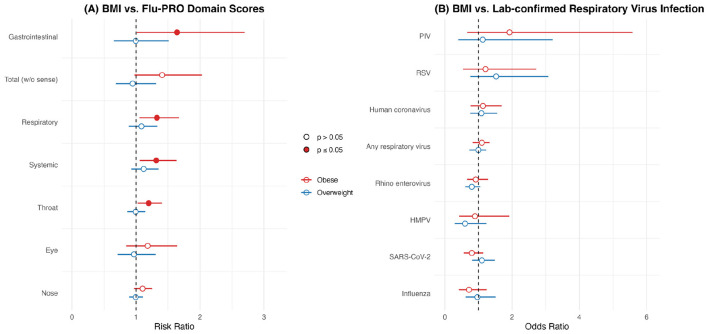
Click to Enlarge: Adjusted associations between BMI category and (A) moderate-to-severe ILI symptom severity measured by Flu-PRO and (B) lab-confirmed respiratory virus infection, using normal/underweight BMI as the reference group. Risk ratios (aRR) were estimated using Poisson regression with robust variance, and odds ratios (aOR) were estimated using logistic regression. Each model was adjusted for confounders identified via directed acyclic graphs. Analyses of lab-confirmed infections were performed separately for each virus type; parsimonious models were used for lab-confirmed influenza, adenovirus, bocavirus, HMPV, PIV, and RSV. Adenovirus and bocavirus were excluded due to small case numbers. BMI, body mass index; Flu-PRO, influenza patient-reported outcome; HMPV, human metapneumovirus; PIV, parainfluenza virus; RSV, respiratory syncytial virus; SARS-CoV-2, severe acute respiratory syndrome coronavirus 2. Source: Frontiers in Public Health
BETHESDA, MD — Having a higher body mass index (BMI) is associated with greater influenza-like illness incidence and symptom severity in adult MHS beneficiaries, according to a recent study.
All of the participants in the study published in Frontiers in Public Health were vaccinated. Those with obesity had higher risks of reporting moderate-to-severe symptoms in 4 domains: gastrointestinal, respiratory, systemic and throat [adjusted risk ratio (aRR) of 1.64 (95% CI: 1.01-2.70), 1.33 (95% CI: 1.05-1.67), 1.32 (95% CI: 1.06-1.63), and 1.20 (95% CI 1.02-1.40) respectively], according to the lead researchers from the Uniformed Services University of the Health Sciences in Bethesda, MD, and colleagues.1
In the United States, seasonal influenza is a major public health issue, and influenza and influenza-like illness, a syndrome defined as fever with cough or sore throat, contribute significantly to morbidity and healthcare utilization in healthy, highly vaccinated military populations. Obesity, a BMI of 30 kg/m2 or higher, has been understood to play a role in severe influenza and other respiratory illnesses such as COVID-19.
As obesity rates increase in the United States, they suggested that understanding the impact of obesity on influenza and influenza-like illness is beneficial, because the relationship between obesity and influenza-like illness incidence and symptom severity is unclear. This information could be used to advise clinical decision making regarding respiratory infections and improve knowledge about the relationship between obesity and respiratory illness outcomes, according to the report.
Study participants were MHS beneficiaries, aged 18 years or older, who were enrolled in a randomized influenza vaccine trial that evaluated the relative effectiveness of three Food and Drug Administration-licensed influenza vaccines. Participants were randomized to receive one of the three influenza vaccines and followed during the influenza season in which they enrolled. The study was conducted across four consecutive influenza seasons (2018 to 2022).
During the influenza season, participants received weekly surveys asking if they had experienced influenza-like illness symptoms during the past week. Those who met the influenza-like illness case definition were asked to complete an online symptom severity questionnaire for 7 days, and schedule two influenza-like illness visits about 28 days apart, to provide influenza-like illness information (e.g., medication, hospitalization and work absence). During the acute visit that was promptly scheduled after confirmation of influenza-like illness, a nasal swab was collected.
The prospective cohort study included participants who responded to at least half of the influenza-like illness surveys and all required demographic variables. BMI was calculated using weight and height reported at enrollment. If this information was missing, anthropometric measures collected at the most recent medical visit around time of enrollment was stratified into three categories: normal/underweight (BMI less than 25 kg/m2), overweight (25 to 29.9 kg/m2) and obese (BMI 30 kg/m2 or higher). Because of the small number of underweight participants, those were combined with the normal weight group for all analyses.
The study also examined four categories of influenza-like illness outcomes: incidence, duration, severity and laboratory-confirmed respiratory infections. The investigators used statistical analyses to compare influenza-like illness risk and influenza-like illness symptom severity across BMI categories.
The authors concluded that obesity is associated with increased influenza-like illness risk and symptom severity. They found that participants with an overweight and obesity-range BMI were more likely to report influenza-like illnesses. Also, adult MHS beneficiaries with obesity had higher risks of reporting moderate-to-severe symptoms in four domains: gastrointestinal, respiratory, systemic and throat.
Among the 8,334 participants who responded to at least half the weekly influenza-like illness surveys, 42% had an overweight-range BMI, and 24% had an obesity-range BMI. The median age of participants was 36.2 years old, and 86% had no baseline comorbidities. More than one-quarter of participants reported at least one influenza-like illness during follow-up, with a median duration of 11 days, the researchers explained.
In participants who reported influenza-like illnesses, at least one respiratory virus was detected in 51.5% of the 2,038 participants with laboratory test results. SARS-CoV-2 was detected in the highest percentage of tested participants (35.4% of 1,010 participants tested for SARS-CoV-2), followed by rhino/enterovirus (17.8%), seasonal human coronavirus (9.0%) and influenza (5.3%) among the 2,038 participants with non–SARS-CoV-2 test results. Age-stratified estimates suggested the association between obesity and influenza-like illness incidence was strongest among participants aged 18 to 39 years old, the investigators determined.
The study’s results aligned with previous studies that identified an association between obesity and influenza-like illness incidence in a vaccinated cohort and in the general U.S. population, the researchers pointed out.
The findings provided evidence to support patient counseling about metabolic health risks and clinical prognostication, the authors advised, adding that the results might also inform research focused on preventive efforts targeting metabolic health and weight management among individuals at risk for respiratory illness. Further research is needed to examine if these obesity countermeasures reduce the risk and outcomes of influenza and influenza-like illness, they suggested.
The results also highlighted the need for further research to understand the immunological differences in patients with obesity, how obesity might influence vaccine response, antiviral effectiveness and illness outcomes for influenza and other respiratory pathogens, the investigators recommended.
Limitations of the study include the potential misclassification of overweight and obesity using BMI, particularly in a population with a high proportion of active-duty military servicemembers. In military populations, BMI may overestimate adiposity among highly fit individuals due to greater muscle mass, but it remains a generally reliable indicator of body composition and cardiometabolic risk at the population level. A direct measurement (i.e., waist circumference and waist-to-hip ratio) might potentially reduce misclassification, but some studies show that BMI is highly correlated with fat mass. Future studies would benefit from multiple measures of overweight and obesity, the researchers pointed out.
Also participating in the study were researchers from The Henry M. Jackson Foundation for the Advancement of Military Medicine Inc. and Walter Reed National Military Medical Center, each in Bethesda, MD; Brooke Army Medical Center, San Antonio; Madigan Army Medical Center in Tacoma, WA: the Defense Health Agency in Falls Church, VA, Carl R. Darnall Army Medical Center in Fort Cavazos, TX; Wilford Hall Ambulatory Surgical Center at Lackland Air Force Base in San Antoniol Womack Army Medical Center at Fort Bragg, NC; Frederick,MD, National Laboratory for Cancer Research; and the U.S. Air Force School of Aerospace Medicine in Wright-Patterson AFB, OH: as well as Wake Forest University School of Medicine in Winston-Salem, NC.
- Gu M, Richard SA, Colombo RE, Schmidt K, et. al. . Assessing the relationship between body mass index and influenza-like illness risk and symptom severity among military health system beneficiaries vaccinated against influenza: a pooled prospective cohort study from a randomized trial. Front Public Health. 2026 Jul 16;14:1874186. doi: 10.3389/fpubh.2026.1874186. PMID: 42534960; PMCID: PMC13422495.