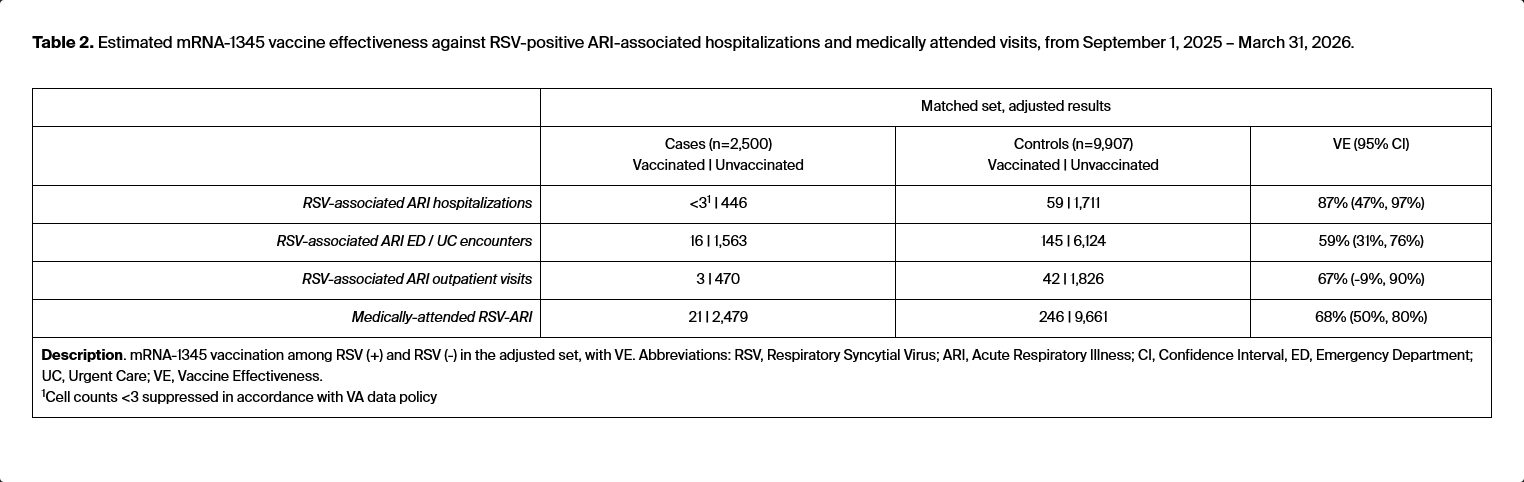
Click to Enlarge: Estimated mRNA-1345 vaccine effectiveness against RSV-positive ARI-associated hospitalizations and medically attended visits, from September 1, 2025 – March 31, 2026. Source: Vaccine
PROVIDENCE, RI — Each year, respiratory syncytial virus (RSV) leads to tens of thousands of hospitalizations among U.S. adults age 65 years and older, with the greatest risk among people with cardiopulmonary disease, diabetes, frailty and immunocompromising conditions. A real-world study of U.S. veterans recently found that the mRNA-1345 (mRESVIA) vaccine was 85% effective against hospitalization associated with RSV-positive acute respiratory illness (ARI).
The study, led by Kevin W. McConeghy, PharmD, PhD, of the VA Providence Healthcare System and published in Vaccine, examined vaccine effectiveness in veteran patients age 50 years and older. It found that mRNA-1345 also was 65% effective against RSV-associated ARI that resulted in medical care, including 57% effectiveness against emergency department or urgent care visits and 71% against outpatient visits.1
Adult RSV vaccines have only recently become available, but the national Centers for Disease Control and Prevention (CDC) already recommends a single dose for all adults age 75 years and older, as well as for adults age 50 to 74 who are at increased risk of severe RSV disease, including people with certain chronic health conditions.
Even though clinical trials demonstrated the efficacy of RSV vaccines, the investigators pointed out that more data would be required to determine how well RSV vaccines protect against severe outcomes in everyday clinical practice.
“Randomized clinical trials of RSV vaccines demonstrated high efficacy against lower respiratory tract disease, despite the differences between the study designs and settings in which the trials were conducted,” they wrote. “Of public health importance, these trials were not powered to evaluate severe outcomes such as hospitalization and underrepresented high-risk populations.”
The researchers also emphasized that “real-world studies are critical to confirm vaccine impact on RSV-related healthcare usage.”
Observational studies can provide additional evidence regarding the effectiveness of RSV vaccines by evaluating vaccine performance in clinical practices and populations that may vary significantly from those involved in clinical trials. Previous observational studies of protein-based RSV vaccines indicated that they were approximately 70-90% effective against RSV-related hospitalization in older adults. However, there was little information available regarding mRESVIA.
Both Abrysvo and Arexvy, the 2 protein-based RSV vaccines, were first approved by the FDA in 2023, followed by mRESVIA in 2024. Uptake of mRESVIA was lower during the 2024-2025 season because many older adults who qualified for mRESVIA had already received another RSV vaccine the previous year. Consequently, this reduced the ability of observational studies to statistically evaluate mRESVIA, according to the investigators.
During the 2025-2026 season, mRNA-1345 was the predominant RSV vaccine used within the VA, giving researchers an opportunity to evaluate its effectiveness against hospitalization and other RSV-associated illness.
Their study was a retrospective, matched test-negative case-control analysis of veterans age 50 years and older who sought care for ARI and had an RSV test performed between Sept. 1, 2025, and April 30, 2026.
The study’s test-negative design compared vaccination rates among patients who tested positive for RSV with those who tested negative. Since both groups sought care and underwent testing for similar illnesses, this method allowed for reduction of confounding caused by healthcare-seeking behaviors.
During the study period, 222,835 veteran patients received RSV tests. Following application of eligibility criteria, the analytical cohort consisted of 91,397 veteran patients, with 1.4% having received mRNA-1345. A total of 3,673 RSV-positive cases and 14,566 RSV-negative controls were included in the matched analysis.
Fewer than 5 of 649 RSV-positive ARI cases admitted to hospitals had been vaccinated, compared to 49 of 2,572 RSV-negative controls in the study. In addition to its effectiveness against hospitalization, mRNA-1345 provided 65% protection against medically attended RSV-associated ARI; specifically, mRNA-1345 provided 57% protection against emergency department/urgent-care visits and 71% protection against outpatient visits. The hospitalization estimate had a 95% confidence interval of 39% to 96%, reflecting uncertainty associated with the small number of vaccinated cases.
The authors described the results as showing “substantial protection against RSV-positive ARI-associated hospitalization” during the 2025-2026 respiratory season.
They noted the hospitalization estimate should be interpreted in the context of the small number of vaccinated cases and its relatively wide confidence interval. Because the study was observational, the findings demonstrate an association between vaccination and reduced risk rather than establishing cause and effect. The results also reflect veterans age 50 years and older who received care within the VA during the study period, so effectiveness estimates may differ in other populations or healthcare settings.
Despite these limitations, the authors said the study adds real-world evidence about mRNA-1345 from a large national healthcare system, highlighting “the public health importance of RSV vaccination programs in populations at risk of severe outcomes.”
- McConeghy KW, Wilker EH, DeVone F, Skov B, et al. Vaccine effectiveness of mRNA-1345 against RSV-associated hospitalization and medically attended acute respiratory illness among US veterans, 2025-2026. Vaccine. 2026 Aug 13;88:128882. doi: 10.1016/j.vaccine.2026.128882. Epub 2026 Jul 9. Erratum in: Vaccine. 2026 Aug 29:129072. doi: 10.1016/j.vaccine.2026.129072. PMID: 42424857.