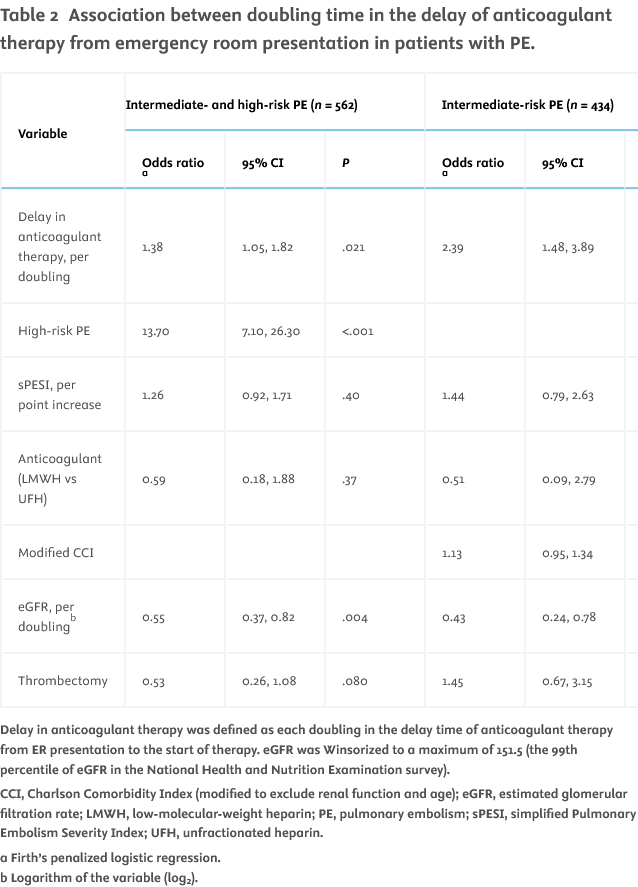
Click to Enlarge: Source: Journal of Thrombosis and Haemostasis
ST. LOUIS — In patients who seek medical care for intermediate- or high-risk pulmonary embolism (PE), delaying the start of anticoagulant therapy is associated with increased odds of PE-related mortality, according to a recent study.
The multicenter retrospective cohort study published in the Journal of Thrombosis and Haemostasis examined the association between the delay in time from symptom presentation of acute PE to the start of anticoagulant therapy and the risk of PE-related mortality.1
PE, a significant cause of mortality, occurs when part of a blood clot breaks off and travels to the lungs. While studies showed a decline in PE-associated mortality until 2007, mortality rates have stopped improving, with higher rates reported in younger people (25 to 64 years old) and Black individuals, the investigators explained.
In patients with PE, treatment with anticoagulant therapy reduces death, and shorter time-to-start of therapeutic anticoagulation may improve PE-related outcomes. However, delayed initiation of anticoagulant therapy is common due to diagnostic uncertainty, delays in diagnostic imaging, comorbidities (e.g., thrombocytopenia, cancer or a history of bleeding) and deferral of the decision regarding anticoagulant therapy to specialists. Previous studies have found that initiating anticoagulant therapy in the emergency department (versus after admission) may reduce mortality, so the time-to-start of anticoagulant therapy could be a modifiable risk factor contributing to PE-related mortality, the study authors pointed out.
This study included patients diagnosed with acute PE between June 2020 and September 2024. Patients were identified using the PE Response Team (PERT) Registry at both the University of Minnesota and Barnes-Jewish Hospital at Washington University in St. Louis. Participants were required to meet the following criteria: age 18 or older, presented to acute-care setting with signs or symptoms of PE (e.g., chest pain, shortness of breath, syncope, etc.), diagnosed with acute intermediate- or high-risk PE per the European Society of Cardiology criteria and received initial anticoagulant therapy with low-molecular-weight heparin (LMWH) or unfractionated heparin (UFH).
A PE diagnosis required imaging with a computed tomography scan or a ventilation/perfusion scan. Anticoagulant therapy start time was defined as the time of first administration of therapeutic UFH (bolus or infusion) or LMWH, as recorded in medical records. The primary outcome was PE-related 30-day mortality. PE-related mortality included: death directly caused by PE or death with PE as a contributing factor (e.g., acute hypoxemic respiratory failure where both pneumonia and PE contributed to death), the researchers explained.
The investigators found that delays in the time-to-start of anticoagulant therapy were associated with increased odds of 30-day PE-related mortality. After adjusting for severity of illness, each doubling of the time-to-start of anticoagulant therapy was associated with a 1.38-fold increase in the odds of PE-related death. This finding was particularly distinct in patients with intermediate-risk PE. In intermediate-risk patients (n = 434), each doubling of the time-to-start of anticoagulant therapy was associated with a 2.4-fold increase in the odds of PE-related death.
“The time from diagnosis to initiation of treatment is crucial in reducing PE-related mortality, and empiric treatment is highly encouraged,” Ozuru Ukoha, MD, MSc, FACS, a national spokesperson for the American Lung Association and chair of the Division of Cardiothoracic Surgery and assistant professor of surgery at Rush University, told U.S. Medicine.
“A clinician should aim to begin anticoagulation therapy for acute intermediate or high-risk pulmonary embolism as soon as the diagnosis is suspected without waiting for confirmatory imaging studies,” Ukoha added. “The improvement in the care of the patients is the decrease in mortality from PE if this recommendation is adhered to.”
Of the 562 patients included in the study, 486 patients (86%) received UFH, and 76 (14%) received LMWH as initial anticoagulant therapy. A total of 108 patients (19%) were diagnosed with intermediate-low-risk PE, 326 (58%) with intermediate-high-risk PE and 128 (23%) with high-risk PE.
The geometric mean of the time-to-start anticoagulant therapy was 231 minutes. PE-related mortality occurred in 64 patients (11%) within 30 days. The geometric mean delay from presentation to anticoagulant therapy was 284 minutes in those who died versus 225 minutes in those who survived, the study reported.
“The difference in geometric mean delay from presentation to anticoagulant therapy in those who died versus those who survived was only about 60 minutes, so clearly, every minute counts,” Ukoha said.
The authors concluded that. if improved, time to anticoagulant therapy is a modifiable risk factor that could reduce the risk of PE-related 30-day mortality in patients with intermediate- and high-risk PE.
Since it’s already common knowledge that anticoagulation is the first line of treatment for PE, the change in practice for clinicians is the vital importance of empiric therapy initiated as soon as the diagnosis is suspected. Another change in practice is the pertinent laboratory panel (D-dimer, Troponin, N-terminal pro B-type natriuretic peptide) and Point-of-Care Ultrasound that should be ordered or considered to enable prompt initiation of anticoagulation therapy while definitive studies are pending, Ukoha recommended.
Ukoha noted that, although the patients in the study were from an acute-care setting, the recommended management of patients presenting with or diagnosed with PE can be applied to inpatient or outpatient settings, especially the initiation of empiric anticoagulation therapy. Also, the choice of UFH or LMWH isn’t as important as making sure anticoagulation therapy is started. If UFH is used, aPTT must be checked often so the patient gets to the therapeutic level as quickly as possible.
Quality improvement efforts in PE—similar to those designed to shorten time from presentation to reperfusion therapy in patients with acute coronary syndrome or ischemic stroke—could reduce the time from presentation to the start of anticoagulant therapy and may improve PE patient outcomes. Quality improvement projects could identify where delays occur in the process (from presentation to diagnosis to treatment of PE), potentially reducing mortality, the investigators suggested.
Limitations of the study include that only patients from two academic sites in urban environments were included, which could limit the generalizability of the findings. Also, because patients were only included if PERT was activated, not every patient diagnosed with PE was captured, and low-risk patients were excluded.
The study also was unable to capture the time from symptom onset to emergency room presentation because patients typically develop symptoms over a period of hours to days. Lastly, most patients in the study received UFH as the initial anticoagulant, so the study’s results may not be generalizable to populations that predominantly receive LMWH, the authors pointed out.
The investigators noted that further research is needed to identify the best strategies to reduce delays in initiating anticoagulant therapy in patients presenting with signs or symptoms of PE. Studies should focus on urgent care and emergency department settings because most patients present to these medical facilities. Further studies are also needed to determine whether LMWH is superior to UFH.
- Bria KE, Gage BF, Gutierrez A, Chiang CJ, Xiong JQ, Flórez-Marqués S, Upchurch C, Beasley M, Sanfilippo KM. Time-to-start of anticoagulant therapy and mortality in pulmonary embolism. J Thromb Haemost. 2026 Jun 18:S1538-7836(26)00391-0. doi: 10.1016/j.jtha.2026.06.014. Epub ahead of print. PMID: 42315027.