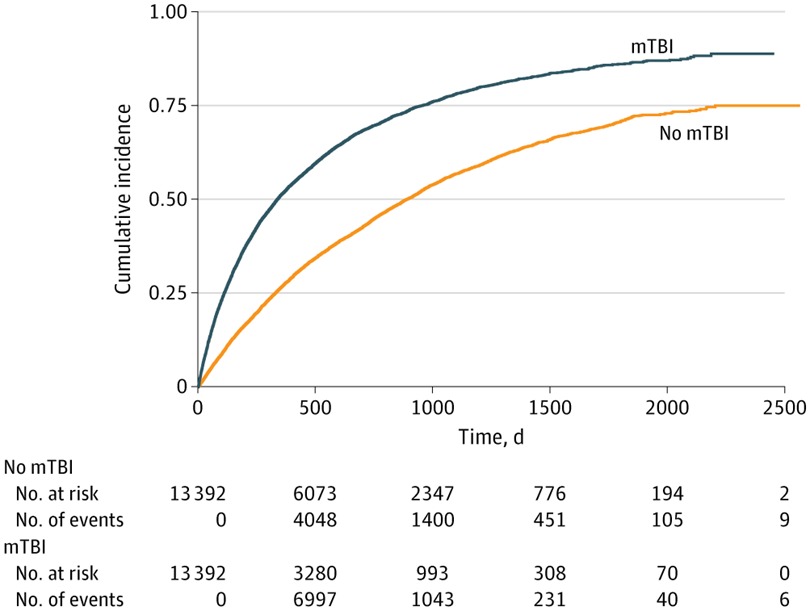
Click to Enlarge: Unadjusted Cumulative Incidence Curve of Musculoskeletal Injury by Mild Traumatic Injury (mTBI) Group During the Full Follow-Up Period Source: JAMA Network Open
SAN DIEGO, — In U.S. servicemembers, mild traumatic brain injury (mTBI) was associated with a greater risk of subsequent musculoskeletal injury. A recent study highlighted the importance of focusing on musculoskeletal injury risk following an mTBI event.
The study published in JAMA Network Open examined whether mTBI is associated with a greater hazard of subsequent musculoskeletal injury among U.S. servicemembers. Because of the growing roles of female servicemembers in the military, the analysis also evaluated how female sex and mTBI exposure interact for subsequent musculoskeletal injuries.1
The study authors are affiliated with the Naval Health Research Center in San Diego; Uniformed Services University of the Health Sciences in Bethesda, MD; and Military and Veterans Health Solutions at Leidos Inc., in San Diego.
Musculoskeletal injuries are a leading cause of morbidity and disability, especially among U.S. servicemembers. These injuries are responsible for the greatest healthcare burden in the U.S. military, serving as the primary reason for nondeployment in about 45% of all medically related cases and 65% of medically nondeployable soldiers in 2017.
Between 2000 to 2024, about 421,760 mTBIs occurred in the U.S. military. Because people with mTBI can exhibit a wide range of impairments that include decision-making, balance, coordination, processing and response to hazards during military activities, subsequent musculoskeletal injuries may occur. To develop targeted prevention efforts, it’s critical to assess musculoskeletal injury risk factors and identify groups at greater injury risk. Even though sex-related differences in mTBI and subsequent musculoskeletal injury rates have been identified in collegiate and nonveteran athletes, the interaction of sex and mTBI exposure on musculoskeletal injury in military servicemembers has been understudied, the investigators explained.
In this matched population-based retrospective cohort study, the researchers used MHS and Military Data Repository (MDR) data through 2023 for female and male U.S. active-duty servicemembers from the Air Force, Army, Marine Corps and Navy of all ages, who joined between 2016 and 2020. The study didn’t include data prior to 2016 because diagnostic tool revisions might have yielded differences in injury classification.
The authors identified mTBI events using International Classification of Diseases, Tenth Revision (ICD-10) codes defined by the Armed Forces Health Surveillance Division. An mTBI event was considered the first mTBI event after the servicemember’s accession date. Musculoskeletal injuries were classified using the Neuromusculoskeletal Epidemiological Outcome (NEO) matrix, which identifies musculoskeletal injuries by anatomical complex and primary tissue type affected using International Classification of Functioning, Disability and Health and ICD-10 codes. A musculoskeletal injury was considered the first musculoskeletal injury event after the servicemember’s mTBI or matching date, whichever occurred first.
The study considered several potentially confounding covariates that may affect both musculoskeletal injury and mTBI, which included age at accession (years), sex (female or male), race and ethnicity (American Indian or Alaska Native or other or unknown, Asian, Black, Hispanic or Latino, or white), occupation (noncombat or combat), rank (enlisted or officer) and service branch (Air Force, Army, Marine Corps or Navy).
For the matched analysis, the investigators identified servicemembers with mTBI and propensity score-matched controls. Statistical analyses were used to test associations of mTBI with subsequent musculoskeletal injury, along with testing for moderation by sex. All models were adjusted for demographic and military-relevant characteristics.
Of the study’s 26,784 participants (13,392 with mTBI and 13,392 controls without mTBI), the research team found that mTBI was associated with a 2.24 times greater hazard of musculoskeletal injury compared with no mTBI.
“There appears to be a bi-directional relationship between musculoskeletal injury and mild traumatic brain injury, and that relationship differs by sex,” Amy Silder, PhD, co-author of the study and a biomedical engineer in the Warfighter Performance Department at Naval Health Research Center, told U.S. Medicine.
The association of mTBI with subsequent musculoskeletal injury was slightly higher among female servicemembers, but the sex-by-mTBI interaction wasn’t statistically significant. Differences in healthcare-seeking and risk-taking behaviors that may impact later-musculoskeletal injury risk could explain the findings. The results can be used to inform patient counseling on musculoskeletal injury risk following mTBI, the investigators suggested.
Among the participants, 4,585 servicemembers (17.1%) were female,1,370 (5.1%) were officers, and 6,667 (24.9%) had a combat-related occupation. The participants had a mean age of 20.0 years, and most were in the Army (51.0%). During 34,156 person-years of follow-up, there were 14,330 musculoskeletal injury events.
“Servicemembers with a history of mTBI may have residual deficits that increase their risk for subsequent musculoskeletal injury,” John J. Fraser, DPT, PhD, a co-author of the study from Naval Health Research Center, told U.S. Medicine. “As such, it is important to evaluate patients with mTBI for physical, psychological and cognitive deficits and treat when appropriate. For patients that present with musculoskeletal injury, we recommend that clinicians inquire to mTBI history and evaluate for physical, psychological and cognitive deficits that may contribute to subsequent injury risk. Bottom line, evaluate and treat the whole patient using a biopsychosocial approach and tailor your approach to the needs of the specific patient.”
Clinicians should inquire as to whether servicemembers had exposure or an event that could result in mTBI. Since the pattern of deficit following mTBI differs in each individual, clinicians should screen servicemembers for deficits unique to that patient, including those in balance, coordination, decision-making, reaction time and other impairments that may contribute to subsequent injury, he advised.
Fraser suggested that primary-care clinicians refer patients with mTBI to rehabilitation and neuropsychological specialists, so that a comprehensive evaluation of balance, agility, coordination, psychological and cognitive function can be completed. For specialists evaluating musculoskeletal injury, inquiry to history of mTBI may help to elucidate specific evaluations and interventions needed during rehabilitation.
From a health system perspective, development and implementation of risk screening, secondary prevention and human performance optimization programs needed to identify and resolve deficits “left of boom” (secondary prevention) are needed in the MHS, in military training and readiness programs, and in the civilian health sector, according to the study. For the VA, a prime opportunity to conduct this screening is when servicemembers transition to veteran status, Fraser pointed out.
Servicemembers with mTBI, as well as military leadership overall, should be educated on the increased risk of musculoskeletal injury following brain injury, the authors recommended. Development and implementation of prevention and warfighter performance optimization programs led by physical therapists, sports medicine physicians, athletic trainers and exercise specialists can help to prevent subsequent musculoskeletal injury, Fraser suggested.
Also, since mTBI and musculoskeletal injury have a negative impact on operational readiness, additional studies on the biologic and behavioral mechanisms driving the sex differences associating mTBI with subsequent musculoskeletal injury are critical, the investigators explained.
- Posis AIB, Silder A, Zouris JM, MacGregor AJ, Fraser JJ, Crouch DJ, Sessoms PH. Mild Traumatic Brain Injury and Subsequent Musculoskeletal Injury in US Service Members. JAMA Netw Open. 2026 Jun 1;9(6):e2619409. doi: 10.1001/jamanetworkopen.2026.19409. PMID: 42313381; PMCID: PMC13280709.