

Updates Based on Injuries Seen in Ukraine, Iran Wars
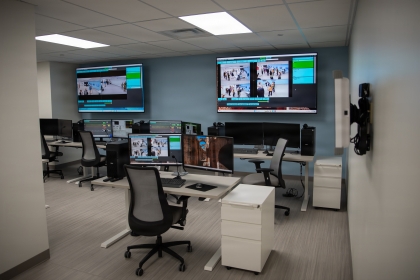
The Air Force recently expanded its Cincinnati Center for Sustainment of Trauma and Readiness Skills (C-STARS). The facility is key to preparing clinicians to handle injuries in a casualty-heavy scenario. U.S. Air Force photo
CINCINNATI, OH — The Air Force recently celebrated a significant expansion of its trauma readiness center in Cincinnati. That is where military medical personnel can hone skills they’ll need to treat combat casualties.
Over the last year, DoD officials have acknowledged that military physicians lack regular practice in trauma care during their daily work lives, which could leave them struggling to keep up with injuries in a casualty-heavy scenario.
The wars in Ukraine and Iran have also demonstrated how drones have changed the scope and shape of combat and increased the danger of treating casualties in-theater–something for which the newly expanded trauma center hopes to prepare physicians.
Established in 2002, the Cincinnati Center for Sustainment of Trauma and Readiness Skills (C-STARS) was created as a partnership between the Air Force and the University of Cincinnati (UC). During that time, it trained over 5,000 Air Force medical professionals.
Initially funded by a $10 million congressional appropriation, the new 30,000-square-foot expansion will triple the center’s training capacity from 100 to 300 medical teams annually and adds a new DARRIO Simulation Center. The simulation center includes a command center, advanced training suites, dedicated research space and an immersive virtual reality environment that is meant to prepare clinicians for the realities of trauma care in the field, during transport and within hospital systems.
“This facility allows us to replicate those high-stress conditions with unparalleled accuracy,” said Col. Valerie Sams, MD, director of C-STARS Cincinnati. “We are setting high standards for readiness, response and resilience.”
The hope is that this kind of training will help fill a growing gap in military physicians’ combat-readiness. A DoD Office of the Inspector General report from June 2025 found that the standard model of assigning physicians to military treatment facilities (MTF) to maintain their trauma skills is lacking and that the Army and Navy did not effectively assign medical personnel to locations where they could maintain wartime medical skills. One critical-care physician reported conducting only 10 procedures between 2018 and 2025. Many physicians assigned to locations that did not provide opportunities for direct care, and 25% of Army and 52% of emergency physicians were not assigned to an MTF at all.
During a congressional hearing in March 2025, it was estimated that only 10% of military surgeons get the patient volume, acuity and variety that they need to be combat ready—one of the reasons DoD is investing in combat-specific virtual training facilities.
“This center represents continued innovation to meet the future needs of our force,” said Brig. Gen. Robert K. Bogart, commander of the 711th Human Performance Wing, during the grand opening ceremonies. “We must prepare for scenarios with a higher volume of patients and more challenging evacuation conditions. This expanded C-STARS Simulation Center is a proactive response for the future fight.”
Those changing combat scenarios are already on display in the wars in Ukraine and Iran where drone attacks can stretch far beyond the front lines and result in large numbers of casualties, both military and civilian. In a study published last year in the British Medical Journal, researchers at the Uniformed Services University of the Health Sciences (USUHS) examined injury patterns in the Ukraine war with the goal of making recommendations on body armor revisions and helping prevent such injuries in the future.1
“Large-scale war employing modern weapons technology is capable of producing high-volume casualties over relatively short periods of time with high acuity and severity of injuries,” the researchers wrote. “Characteristic injuries such as blast wounds, head injuries, multi-limb traumatic amputations and open fractures not only carry a high risk of mortality but also demand extensive medical care and rehabilitation.”
They noted that the existence of drones drastically changes how safely casualties can be treated on or even near the battlefield.
“The absence of effective air superiority during large-scale combat operations also challenges the conventional approach used by the U.S. military and the North Atlantic Treaty Organization (NATO) to medically evacuate combat casualties,” they explained.
One of six C-STARS nationwide, the center in Cincinnati also will serve as a national research hub, with the goal of helping to shape future combat medical doctrine.
“Every time we step into this simulation center, we’re reminded that our research isn’t about equipment—it’s about saving lives,” said Jim Lehman, the UC Medical research site lead. “If our work helps medics bring one more servicemember home safely, then every hour spent here is worth it.”
- Lawry LL, Mani V, Hamm TE, Janvrin M, Juman L, Korona-Bailey J, Maddox J, Berezyuk O, Schoenfeld AJ, Koehlmoos TP. Qualitative assessment of combat-related injury patterns and injury prevention in Ukraine since the Russian invasion. BMJ Mil Health. 2026 Mar 20;172(2):154-159. doi: 10.1136/military-2024-002863. PMID: 39904535; PMCID: PMC13018771.