Calls Misrouted, Disconnected or Forwarded to a Nonfunctional Number
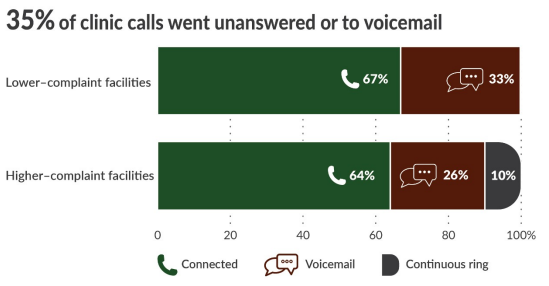
Click to Enlarge: Distribution of calls for lower- and higher-complaint sampled facilities.
Source: VA OIG testing results for the specialty care clinics reviewed in November and
December 2025 Source: VA Office of Inspector General (OIG)
WASHINGTON, DC — More than 1 in 5 veterans calling to set up a specialty care appointment with VA were misrouted, disconnected or forwarded to a nonfunctional telephone number, according to a VA Office of the Inspector General (OIG) investigation. These included clinics that serve high-risk patients such as radiology and mental health, where delays in care can lead to lasting patient harm. Many facilities were unaware of the problem, with some unsure of who was responsible for updating clinic phone numbers.
Investigators looked at clinics for six specialty care services at 15 facilities that have received patient complaints. They found that 36% of specialty care phone numbers were incorrect or entirely nonfunctional. During the yearlong OIG review period, those clinics received 2.9 million calls from veterans. Of those, 573,000 went to inaccurate numbers.
“In addition, 11 facilities lacked interactive options to route veterans directly to specialty care clinics, undermining first-call resolution and causing delays and repeat calls,” investigators reported. “About 530,000 of the 2.9 million calls went to voicemail; many veterans complained in the patient advocate system about full voicemail boxes and unreturned messages.”
Nearly half of veterans trying to reach mental health specialty care were given inaccurate numbers, as were 16% of veterans trying to reach radiology.
The report described veterans being sent from one number to another with no resolution, while others waited in telephonic limbo before being disconnected.
“Some veterans waited on hold with the radiology clinic for up to 30 minutes or experienced continuous ringing for about 10 minutes before being disconnected. In one complaint, a veteran reported he needed to undergo ‘serious tests’ but was given three different phone numbers for the radiology clinic by VA staff; all were incorrect, and he was unable to be transferred by the operator, who also lacked the correct number,” investigators said. “Additionally, several other patient complaints indicated that veterans attempted to call the mental health clinic to schedule appointments, but the line would ring multiple times before automatically disconnecting.”
Unable to reach clinics by phone, some veterans have been driving long distances to make an appointment in person.
“In Washington, DC, the OIG team observed a veteran in the audiology clinic telling scheduling staff that, after multiple unanswered phone calls, he decided to drive to the facility to make an appointment,” the investigators wrote. “Similarly, at the Miami facility, the OIG observed a veteran scheduling an appointment at the audiology clinic and telling staff he would need to visit the podiatry clinic in person to schedule an appointment there as well.”
Investigators discovered that, not only were phone directories inconsistently updated, but some staff did not know how to do it or who to contact to have it done. They also did not always check to ensure the phone numbers on their websites were correct. Leaders of the facilities with the highest number of patient complaints told investigators they lacked a formal way to update their websites. Even facilities that assured investigators there was a process in place were found to have incorrect numbers.
VHA has a performance metric for call answering and response, with the goal being an average answer speed of 30 seconds, with 80% falling under that number, and 5% or fewer calls going abandoned. However, when OIG questioned leaders from VHA’s Specialty Care Program Office and Office of Integrated Veteran Care–the offices with oversight over medical specialty care–they were told that those leaders had misunderstood the scope of the regulations and “were generally not aware that VHA call performance standards apply to specialty care clinics.”
The office had been focused on clinical contact centers, but after reviewing language in the directive they confirmed that it also applies to service lines providing specialty care. The leaders told investigators that this lack of awareness at headquarters could have trickled down to facilities.
“Without national guidance and monitoring, veterans seeking specialty care remain at risk of delays in accessing care, uncertainty about when they will receive care and frustration when attempting to schedule and manage care, particularly for high-risk health conditions associated with radiology services and mental health treatment,” the investigators stated.
In response to the report, VHA has submitted an action plan to create a process to routinely update these numbers, as well as one to conduct an annual review making sure systems are routing calls correctly. These plans are targeted for completion by May 2027.
- Review of Medical Facilities’ Management of Specialty Care Calls, VA OIG 25-03621-145 | Page 26 | July 23, 2026