Legislators Not So Sure
Click to Enlarge Source: VA
WASHINGTON, DC — VA is planning to cut its IT budget and shed more than 10% of the Office of Information Technology (OIT) staff in a restructuring effort intended to streamline and improve services for veterans.
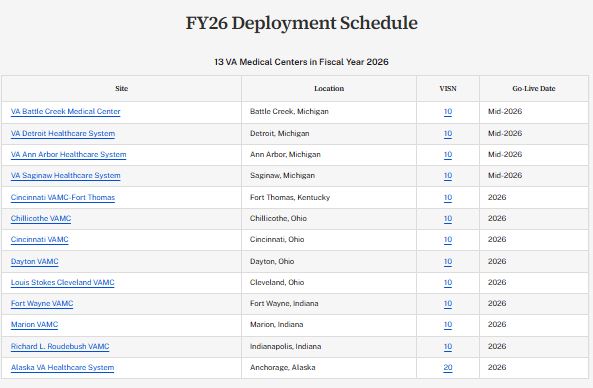
At the same time, it has scheduled a reignition of its emergency health record (EHR) rollout for 2026 after pausing the project for more than 2 years.
Democrats expressed concerns that staffing cuts are being done haphazardly, and VA watchdogs are deeply skeptical that the agency has the information required to do a proper and effective IT restructuring.
VA’s proposed FY2026 budget includes $7.3 billion for IT systems—a $300 million decrease from 2025. That includes funding for approximately 7,000 full-time equivalent employees—an 11.7% decrease from 2025. According to VA, as of July, 1,172 OIT employees had left through the Deferred Resignation Program (DRP) or the Voluntary Early Retirement Program (VERA).
“We are reshaping OITs workforce to achieve veteran-facing outcomes with speed and precision,” Acting CIO Eddie Pool testified to the House VA Subcommittee on Technology Modernization. “[This strategic realignment] is designed to cut bureaucratic overhead, accelerate decision-making and focus every OIT position on delivering secure, reliable, modern IT solutions.”
The phrase Pool kept returning to was “maximizing value.” Anything that did not bring maximum value to veterans would be “repurposed and reinvested,” he said.
OIT leaders stressed that it was “back office and administrative support” positions that are being evaluated most closely, since they feel these will have the greatest redundancies. The example Pool gave several times was that OIT had built its own human resources (HR) function—a service that can be provided by the department-level HR office.
Asked whether this effort is having a negative effect on the morale of remaining employees, Pool responded, “Obviously, change is very challenging. In this particular instance, change is very necessary. [This is an] opportunity to improve things at VA on a scale not seen before.”
Democrats on the subcommittee were skeptical that these reductions would not have unexpected, negative impacts on VA’s IT functions.
“You say these folks are providing support, but my concern is that [they do] support the overall mission of OIT. At what level and at what point does that type of a level of vacancies erode the overall mission of OIT?” asked Rep. Nikki Budzinski (D-IL). “When you were accepting these early retirements or resignations, how did you consider that? Does it in any way erode what you’re trying to accomplish?”
One concern is that VA might not be in a position to fully answer that question or to navigate a major IT office restructuring at all. There have been numerous VA inspector General and Government Accountability Office (GAO) reports documenting VA’s decades-long history of IT project failures and struggling programs. One of the root causes of those failures, as identified by inspectors, is a poor understanding of VA’s IT resources, and a lack of proper planning and oversight.
A GAO report released in December 2024 found VA’s strategic workforce plan to be incomplete at even the basic level.
“They don’t have an inventory of their current workforce skills and competencies,” testified Carol Harris, GAO director of Information Technology and Cybersecurity. “In terms of restructuring, not even having a baseline of what it is that they have, it’s going to be difficult to tell … what you need in the future. They also didn’t identify their future needs in human skills and competencies. Those are essential things that you’re going to need with any reform effort.”
Over the years, GAO has developed a list of best practices for federal agencies undergoing attempted streamlining, Harris explained. That includes making sure VA can answer some basic questions about where it currently is, where it wants to be, and how it is it making decisions to get from one place to the other.
“What data and evidence has the agency used to develop and justify its proposed reforms?” Harris asked. “How has the agency ensured their continued delivery of services during reform implementation? To what extent has the agency conducted strategic workforce planning to determine whether it will have the needed resources and capacity, including the skills and competencies, in place for the proposed reform?”
While VA officials were unable to answer those questions in detail at the hearing, Harris said she hopes the department can pivot in order to answer them in the near future.