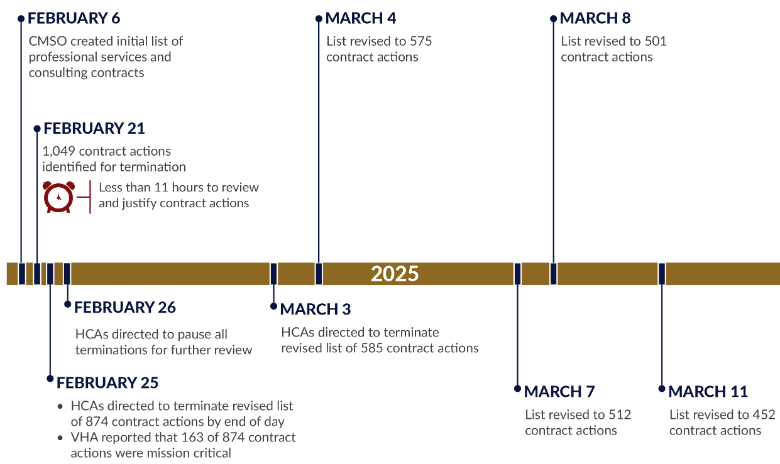
Click to Enlarge: Timeline of key events from February through March 2025.
Abbreviations: HCA, head of contracting activity; VHA, Veterans Health Administration.
Source: VA OIG analysis of emails and lists of contracts.
WASHINGTON, DC — VA cancelled hundreds of vendor contracts totaling $1.1 billion during a Department of Government Efficiency (DOGE)-led review in 2025, according to a review by the VA Office of the Inspector General. The audit was requested by Democratic legislators concerned about the impact of cancellations, the speed at which they were being canceled and the use of AI and algorithms in deciding which contracts would be terminated.
While investigators found that VA complied with federal acquisition guidelines, the speed at which the cuts were made overwhelmed VA staff, leading to incorrect information being given to Congress during the height of the purge.
On Feb. 26, 2025, President Donald Trump issued an executive order directing agencies to review all existing contracts and terminate or modify ones that were redundant or that agency staff could accomplish themselves. According to the report, from January through June 2025, VA received several requests from the Government Services Administration, VA senior advisers and DOGE to terminate specific contracts.
“To reduce the risk of the risk of ending critical services, VA established procedures to review the contracts before acting on the requests,” the report stated. “Despite challenges created by the speed and volume of these requests, VA contracting officials generally complied with [federal acquisitions] requirements when terminating contracts.”
Of its over 90,000 contracts, VA examined a total of 2,210 contract actions. A single contract can encompass multiple contract actions, including delivery orders, task orders and purchase orders. Of the ones VA reviewed, a total of 435 were terminated, and an additional 100 were terminated then reinstated. OIG identified 86% of these contracts as consulting services predominantly focused on program and administrative management, as well as strategic communications.
The report found that the speed at which VA officials were asked to terminate contracts caused frustration at the department and later resulted in confusion among lawmakers tasked with oversight. On Feb. 21, a senior adviser directed department officials to review 1,049 contract actions. VA staff were given less than 11 hours to complete the review—a deadline that many offices were unable to meet. On Feb. 25, senior advisers along with DOGE representatives directed VA to terminate the contracts regardless of review status. The following day, VA paused all terminations until reviews were finished.
Over the next month, the list of contract actions on the cutting block was revised multiple times. Not only did the total number of contracts change, but so did the formatting of the lists. VA told investigators they had to task staff full-time to track and monitor the lists.
VA submitted two lists of terminated contracts to Congress, one in May 2025 and another in July 2025. Both were incomplete and inaccurate. The May list stated that VA had terminated a total of 446 contract actions with a value of $120.9 billion, over 100 times the actual amount. One contract action was listed as being worth over $21 billion, while its actual estimated value was $74 million.
According to a VA acquisitions officer, a dashboard created to track the terminated contracts miscalculated contract values. The list of canceled contracts was also incorrect, listing 11 that had been terminated and then reinstated and 78 that had never been canceled at all.
The July list included only 1,664 contract actions estimated at $1.4 billion but again included incorrect information. OIG found that VA terminated only 366 of the contract actions on the list, 17 of which it later reinstated.
Acquisition officials told investigators that, like the first list, “VA senior advisers and Department of Government Efficiency representatives who contributed to the information provided to Congress were unfamiliar with contracting and acquisition terminology, which may have caused mischaracterizations in the list.”
One acquisition official told OIG that DOGE representatives “wanted to claim credit for any contracts that ended, including those that simply reached the end of their performance period, such as completed supply and installation contracts.” Consequently, the list included 974 supply-related contract actions for items like prosthetics, surgical implants and wheelchair ramps.
While the process might have been flawed, OIG concluded that the wave of terminations was accomplished in line with federal standards.
“Despite a challenging and fast-paced process, VA officials implemented procedures to review contracts before terminating them, which reduced the risk of terminating critical services,” the investigators concluded.
Sen. Richard Blumenthal (D-CT), one of the legislators who originally requested the audit, said he remains unsatisfied. The report, he said, failed to include an additional 32 contracts that were reinstated because they directly impacted patient care. It also did not address 842 contracts that expired and were not renewed due to DOGE recommendations.