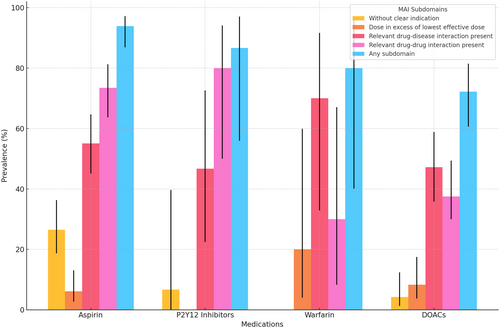
Click to Enlarge: Prevalence of Medication Appropriateness Index (MAI) Subdomains by Medication. The chart demonstrates the rates of each subdomain for each antithrombotic as well as the overall rate of likely or potentially inappropriate use.
Source: Journal of the American Geriatrics Society
CHAPEL HILL, NC — Antiplatelet and anticoagulant medications often are prescribed for older adults who suffer atherosclerotic and thromboembolic disease.
A new study raised concerns, however, about whether the benefits of those drugs outweigh the risk of traumatic hemorrhage in older adults with elevated fall risk.
Noting that emergency department (ED) providers are in a good position to identify opportunities to deprescribe likely inappropriate antithrombotics following an emergency visit for a fall, University of North Carolina-Chapel Hill-led researchers sought to determine the prevalence of likely inappropriate antithrombotic use among older adults presenting to an ED with a fall.
The results were published in the Journal of the American Geriatric Society.1
Among the institutions participating in the study was the Center for Health Equity Research and Promotion at the VA Pittsburgh Healthcare System.
The study was a secondary analysis of earlier research involving older adults presenting to an ED with a fall; those participants were enrolled from 2020 to 2021 in a pharmacist-led medication reconciliation program at a Southeastern academic ED. For the recent study, the authors used the Medication Appropriateness Index (MAI) to assess antithrombotic appropriateness, categorized appropriate (MAI = 0), potentially inappropriate (MAI = 1-2) and likely inappropriate (MAI ≥ 3).
The study team determined that 171 out of 514 enrolled patients who presented with a fall to the ED were on an antithrombotic. They had a mean age of 81.2 years; 66.1 were female, and their median MAI score was 2 (IQR: 2-4).
“Potentially inappropriate or likely inappropriate use was observed in 82.5% (141/171; 95% CI: 76.0%-87.5%) of participants,” the study advised. “Aspirin had the highest prevalence of likely inappropriate use at 60% (59/98; 95% CI: 50%-69%), while P2Y12 inhibitors, warfarin, and direct oral anticoagulants had prevalence of likely inappropriate use at 53% (8/15; 95% CI: 27%-78%), 30% (3/10; 95% CI: 8%-67%), and 29% (21/72; 95% CI: 20%-41%), respectively.”
Is Use Inappropriate?
The researchers identified “a high prevalence of likely inappropriate antithrombotic use among older adults presenting to the ED with a fall. While aspirin had the highest rate of likely inappropriate use, all antithrombotics had 30% or greater rates of likely inappropriate use. An ED encounter presents a critical opportunity to evaluate the appropriateness of antithrombotic use in patients who have fallen.”
A recent Canadian study counterbalanced those concerns, however. The study led by CHU de Québec-Université Laval in Québec specifically evaluated the association between antithrombotic medications and intracranial hemorrhage among older patients with mild traumatic brain injury.
The study published in the European Journal of Emergency Medicine sought to quantify the association between antithrombotic (AT) medications (anticoagulant and antiplatelet) and risk for traumatic intracranial hemorrhage (ICH) in older adults with a mild traumatic brain injury (mTBI).2
The research team conducted a retrospective multicenter study across 103 emergency departments affiliated with a teleradiology company dedicated to emergency imaging between 2020 and 2022. Included were 5,948 adults 65 and older with mTBI and with a head computed tomography scan. The participants had a median age of 84.6 and 58.1% were female; 13.1% of them had an ICH. Among those, 3,177 (53.4%) patients were treated with at least one AT agent.
Their results indicated that no AT medication was associated with a higher risk for ICH: antiplatelet odds ratio 0.98 95% confidence interval (0.81-1.18), direct oral anticoagulant 0.82 (0.60-1.09) and vitamin K antagonist 0.66 (0.37-1.10).
Factors linked to greater ICH risk were:
- a high-level fall [1.68 (1.15-2.4)],
- a Glasgow coma scale of 14 [1.83 (1.22-2.68)],
- a cutaneous head impact [1.5 (1.17-1.92)],
- vomiting [1.59 (1.18-2.14)],
- amnesia [1.35 (1.02-1.79)],
- a suspected skull vault fracture [9.3 (14.2-26.5)] or
- facial bones fracture [1.34 (1.02-1.75)]
“This study found no association between AT medications and an increased risk of ICH among older patients with mTBI suggesting that routine neuroimaging in this population may offer limited benefit and that additional variables should be considered in the imaging decision,” the authors wrote.
- Klickstein LC, Niznik J, Branham V, George H, et. Al. Appropriateness of Antiplatelets and Anticoagulants Among Older Adults Experiencing Falls. J Am Geriatr Soc. 2025 Sep 27. doi: 10.1111/jgs.70127. Epub ahead of print. PMID: 41014071.
- Benhamed A, Crombé A, Seux M, Frassin L, L’Huillier R, Mercier E, Émond M, Millon D, Desmeules F, Tazarourte K, Gorincour G. Association between antithrombotic medications and intracranial hemorrhage among older patients with mild traumatic brain injury: a multicenter cohort study. Eur J Emerg Med. 2025 Oct 1;32(5):359-367. doi: 10.1097/MEJ.0000000000001246. Epub 2025 Jul 1. PMID: 40590793.